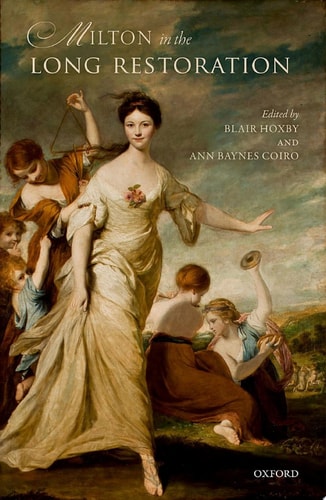
Milton in the Long Restoration
0
0
As an Amazon Associate and affiliate partner, Menrva Books earns from qualifying purchases. Learn more
Author Description
Milton criticism often treats the poet as if he were the last of the Renaissance poets or a visionary prophet who remained misunderstood until he was read by the Romantics. At the same time, literary histories of the period often invoke a Long Eighteenth Century that reaches its climax with the French Revolution or the Reform Bill of 1832. What gets overlooked in such accounts is the rich story of Milton's relationship to his contemporaries and early eighteenth-century heirs. The essays in this collection demonstrate that some of Milton's earliest readers were more perceptive than Romantic and twentieth-century interpreters. The translations, editions, and commentaries produced by early eighteenth century men of letters emerge as the seedbed of modern criticism and the term 'neoclassical' is itself unmasked as an inadequate characterization of the literary criticism and poetry of the period—a period that could brilliantly define a Miltonic sublime, even as it supported and described all the varieties of parody and domestication found in the mock epic and the novel. These essays, which are written by a team of leading Miltonists and scholars of the Restoration and eighteenth century, cover a range of topics—from Milton's early editors and translators to his first theatrical producers; from Miltonic similes in Pope's Iliad to Miltonic echoes in Austen's Pride and Prejudice; from marriage, to slavery, to republicanism, to the heresy of Arianism. What they share in common is a conviction that the early eighteenth century understood Milton and that the Long Restoration cannot be understood without him.
Menrva's Summary
THE THESIS
This collection investigates how the early eighteenth-century reception of John Milton serves as a critical foundation for understanding the literary and political landscape of the Long Restoration. Edited by Ann Baynes Coiro and Blair Hox, the volume brings together leading scholars to challenge the traditional narrative that Milton was only truly understood by the Romantics. By analyzing early editions, translations, and commentaries, the authors argue that the period's engagement with Milton was far more sophisticated and influential than previous literary histories have acknowledged.
THE SCOPE MAP
What You Will Find
- Analysis of early eighteenth-century Miltonic editors, translators, and theatrical producers.
- Examinations of Miltonic influence in the works of Alexander Pope and Jane Austen.
- Discussions on thematic intersections including republicanism, Arianism, marriage, and slavery.
- Re-evaluation of the term 'neoclassical' in the context of contemporary literary criticism.
Scope Limits
- The text does not provide a comprehensive biography of Milton.
- It does not cover the full breadth of Milton's own writings, focusing instead on his reception and legacy.
THE AUTHORITY PERSPECTIVE
Scholars view this collection as a significant intervention in Milton studies that effectively bridges the gap between the Renaissance and the Romantic era. The essays are noted for their academic rigor and their ability to reframe the intellectual history of the eighteenth century through the lens of Miltonic influence.
Page Count:
655
Publication Date:
2016-01-01
Publisher:
OUP Oxford
ISBN-10:
0191082406
ISBN-13:
9780191082405
History
Poetry
English literature
Literary Criticism
English & College Success
Eighteenth Century
English
Restoration Literature
Community Tags
Similar Books