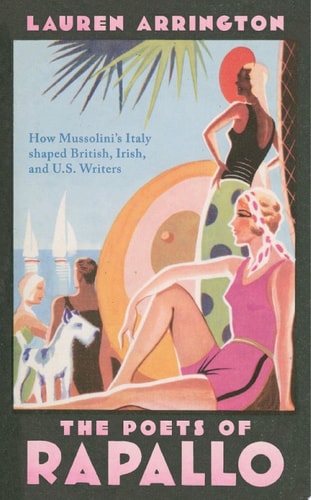
The Poets of Rapallo: How Mussolini's Italy Shaped British, Irish, and U.S. Writers
0
0
As an Amazon Associate and affiliate partner, Menrva Books earns from qualifying purchases. Learn more
Author Description
A new story about the relationships between major twentieth-century English-language poets. Why did poets from the United States, Britain, and Ireland gather in a small town in Italy during the early years of Mussolini's regime? These writers were--or became--some of the most famous poets of the twentieth century. What brought them together, and what did they hope to achieve? The Poets of Rapallo is about the conversations, collaborations, and disagreements among Ezra and Dorothy Pound, W.B. and George Yeats, Richard Aldington and Brigit Patmore, Thomas MacGreevy, Louis Zukofsky, and Basil Bunting. Drawing on their correspondence, diaries, drafts of poems, sketches, and photographs, this book shows how the backdrop of the Italian fascist regime is essential to their writing about their home countries and their ideas about modern art and poetry. It also explores their interconnectedness as poets and shows how these connections were erased as their work was polished for publication. Focusing on the years between 1928 and 1935, when Pound and Yeats hosted an array of visiting writers, this book shows how the literary culture of Rapallo forged the lifelong friendships of Richard Aldington and Thomas MacGreevy--both veterans of the First World War--and of Louis Zukofsky and Basil Bunting, who imagined a new kind of "democratic" poetry for the twentieth century. In the wake of the Second World War, these four poets all downplayed their relationship to Ezra Pound and avoided discussing how important Rapallo was to their development as poets. But how did these "democratic" poets respond to the fascist context in which they worked during their time in Rapallo? The Poets of Rapallo discusses their collaboration with Pound, their awareness of the rising tide of fascism, and even--in some cases--their complicity in the activities of the fascist regime. The Poets of Rapallo charts the new direction for modernist writing that these writers imagined, and in the process, it exposes
Menrva's Summary
THE THESIS
This book investigates how the specific political and social environment of Mussolini's Italy influenced the creative output and ideological development of a prominent circle of British, Irish, and American modernist poets. Lauren Arrington, a scholar of twentieth-century literature, utilizes a vast array of primary source materials—including personal correspondence, unpublished drafts, and photographs—to argue that the Rapallo literary scene was a crucible for modernism. She posits that the proximity to Italian fascism fundamentally shaped these writers' views on art, democracy, and their own national identities, despite their later efforts to obscure these connections.
THE SCOPE MAP
What You Will Find
- Analysis of the social and intellectual interactions between Ezra Pound, W.B. Yeats, Richard Aldington, Thomas MacGreevy, Louis Zukofsky, and Basil Bunting.
- Examination of the period between 1928 and 1935 in Rapallo, Italy.
- Investigation into the intersection of modernist aesthetics and fascist political contexts.
- Documentation of how personal and professional relationships were sanitized in later published works.
Scope Limits
- The study focuses primarily on the specific group of writers gathered in Rapallo and does not provide a comprehensive history of the entire modernist movement.
- The book does not offer a definitive moral judgment on the poets' political complicity, focusing instead on documenting their activities and responses.
THE AUTHORITY PERSPECTIVE
Scholars and critics recognize this work as a significant contribution to modernist studies, particularly for its archival rigor in uncovering suppressed connections between major literary figures. Readers frequently note the academic density of the prose, which provides a detailed, evidence-based look at a previously under-examined chapter of literary history.
Page Count:
248
Publication Date:
2021-01-01
Publisher:
OUP Oxford
ISBN-10:
0192585665
ISBN-13:
9780192585660
Poetry
History
Biography
English
Modernism
Literary Criticism
European History
English literature
English & College Success
Community Tags
Similar Books