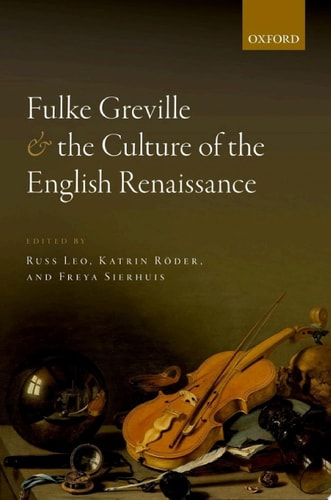
Fulke Greville and the Culture of the English Renaissance
0
0
As an Amazon Associate and affiliate partner, Menrva Books earns from qualifying purchases. Learn more
Author Description
Fulke Greville's reputation has always been overshadowed by that of his more famous friend, Philip Sidney, a legacy due in part to Greville's complex moulding of his authorial persona as Achates to Sidney's Aeneas, and in part to the formidable complexity of his poetry and prose. This volume seeks to vindicate Greville's 'obscurity' as an intrinsic feature of his poetic thinking, and as a privileged site of interpretation. The seventeen essays shed new light on Greville's poetry, philosophy, and dramatic work. They investigate his examination of monarchy and sovereignty; grace, salvation, and the nature of evil; the power of poetry and the vagaries of desire, and they offer a reconsideration of his reputation and afterlife in his own century, and beyond. The volume explores the connections between poetic form and philosophy, and argues that Greville's poetic experiments and meditations on form convey penetrating, and strikingly original contributions to poetics, political thought, and philosophy. Highlighting stylistic features of his poetic style, such as his mastery of the caesura and of the feminine ending; his love of paradox, ambiguity, and double meanings; his complex metaphoricity and dense, challenging syntax, these essays reveal how Greville's work invites us to revisit and rethink many of the orthodoxies about the culture of post-Reformation England, including the shape of political argument, and the forms and boundaries of religious belief and identity.
Menrva's Summary
THE THESIS
This volume investigates the intentional complexity of Fulke Greville’s literary output to determine how his perceived obscurity functions as a deliberate philosophical and poetic strategy. The editors, Freya Sierhuis, Katrin Röder, and Russ Leo, compile seventeen scholarly essays that analyze Greville’s work within the context of post-Reformation English culture. By examining his poetry, drama, and political treatises, the contributors argue that Greville’s dense syntax and paradoxical style represent a sophisticated engagement with sovereignty, theology, and the limits of human expression.
THE SCOPE MAP
What You Will Find
- Analysis of Greville’s poetic techniques, including caesura usage and feminine endings
- Examination of political arguments regarding monarchy and sovereignty
- Theological inquiries into grace, salvation, and the nature of evil
- Historical context regarding Greville’s reputation and his relationship with Philip Sidney
Scope Limits
- The volume does not provide a comprehensive biography of Greville’s life
- The essays do not attempt to simplify or modernize Greville’s challenging syntax for a general audience
THE AUTHORITY PERSPECTIVE
Experts identify this collection as a significant contribution to Renaissance studies, particularly for its focus on the intersection of poetic form and political philosophy. Readers frequently note the academic density of the prose, which is intended for scholars and advanced students of early modern literature.
Page Count:
353
Publication Date:
2018-01-01
Publisher:
OUP Oxford
ISBN-10:
0192568752
ISBN-13:
9780192568755
Poetry
History
Philosophy
English literature
English & College Success
Political Theory
English
Literary Criticism
English Renaissance
Community Tags
Other Editions(3)
Similar Books

Reader Comments
Share Your Thoughts
No comments yet. Be the first to share your thoughts!