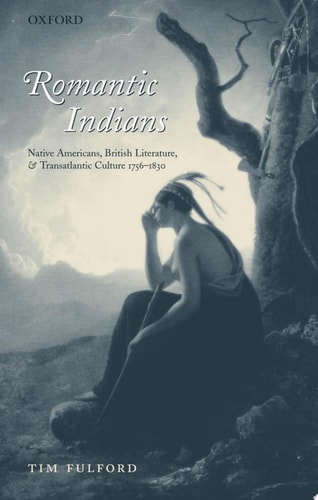
Romantic Indians: Native Americans, British Literature, and Transatlantic Culture 1756-1830
0
0
As an Amazon Associate and affiliate partner, Menrva Books earns from qualifying purchases. Learn more
Author Description
Romantic Indians considers the views that Britons, colonists, and North American Indians took of each other during a period in which these people were in a closer and more fateful relationship than ever before or since. It is, therefore, also a book about exploration, empire, and the forms of representation that exploration and empire gave rise to-in particular the form we have come to call Romanticism, in which 'Indians' appear everywhere. It is not too much to say that Romanticism would not have taken the form it did without the complex and ambiguous image of Indians that so intrigued both the writers and their readers. Most of the poets of the Romantic canon wrote about them-not least Southey, Wordsworth, and Coleridge; so did many whom we have only recently brought back to attention-including Bowles, Hemans, and Barbauld. Yet Indians' formative role in the aesthetics and politics of Romanticism has rarely been considered. Tim Fulford aims to bring that formative role to our attention, to show that the images of native peoples that Romantic writers received from colonial administrators, politicians, explorers, and soldiers helped shape not only these writers' idealizations of 'savages' and tribal life, but also their depictions of nature, religion, and rural society. The romanticization of Indians soon affected the way that real native peoples were treated and described by generations of travellers who had already, before reaching the Canadian forest or the mid-western plains, encountered the literary Indians produced back in Britain. Moreover, in some cases Native Americans, writing in English, turned the romanticization of Indians to their own ends. This book highlights their achievement in doing so-featuring fascinating discussions of several little-known but brilliant Native American writers.
Menrva's Summary
THE THESIS
This book investigates how the image of Native Americans in British literature between 1756 and 1830 fundamentally shaped the aesthetics, politics, and development of the Romantic movement. Tim Fulford, a scholar of Romantic literature, utilizes a wide array of historical documents, colonial records, and literary texts to argue that the 'Indian' was not merely a peripheral subject but a central, formative influence on British writers. By examining the interplay between imperial expansion and literary representation, the author demonstrates how these constructed images influenced both the philosophical ideals of the era and the actual treatment of indigenous peoples.
THE SCOPE MAP
What You Will Find
- Analysis of major Romantic poets including Southey, Wordsworth, and Coleridge alongside lesser-known figures like Bowles, Hemans, and Barbauld.
- Examination of the feedback loop between colonial exploration reports and British literary output.
- Discussion of Native American authors who utilized the English language to subvert or reclaim romanticized tropes.
Scope Limits
- The study is strictly confined to the transatlantic cultural exchange between 1756 and 1830.
- It does not provide an exhaustive history of all Native American tribes, focusing instead on the literary and political representations of indigenous peoples within the British context.
THE AUTHORITY PERSPECTIVE
Scholars and historians frequently cite this work as a significant contribution to the study of how colonial encounters informed the development of Romantic aesthetics. Experts highlight the text for its ability to bridge the gap between literary criticism and historical analysis, making it a valuable resource for those studying the intersection of empire and literature.
Page Count:
336
Publication Date:
2006-01-01
Publisher:
OUP Oxford
ISBN-10:
0191534234
ISBN-13:
9780191534232
History
English
Native American
Romanticism
English & College Success
Literary Criticism
British literature
Community Tags
Other Editions(2)

Similar Books
Reader Comments
Share Your Thoughts
No comments yet. Be the first to share your thoughts!