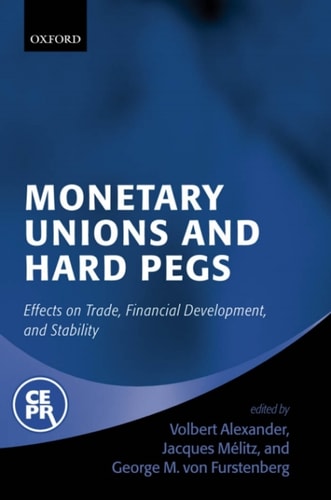
Monetary Unions and Hard Pegs: Effects on Trade, Financial Development, and Stability
0
0
As an Amazon Associate and affiliate partner, Menrva Books earns from qualifying purchases. Learn more
Author Description
Financial services with global reach are becoming ever more important in the conduct and organization of the trade and investment of nations, and currencies that lack international standing lose out in this business. The result of financial development has been destabilizing currency and portfolio substitution — in favour of international currencies and against local ones. This book analyses formal approaches to overcoming monetary divisions within countries and within integrating regions, focusing on the consequences of monetary union for trade among union members and their financial development and stability. The authors discuss hard pegs such as those attempted by the currency board of Argentina, outright dollarization, such as in Ecuador, and multilateral monetary union, as in Europe, the least reversible form of monetary union and the most powerful elixir of financial integration and trade. The political classes and central banks in most countries have been reluctant to admit the market- and technology-driven forces of currency consolidation, much less yield to them. International financial institutions too are still in the habit of proffering advice about national monetary and exchange-rate policies on the assumption that getting rid of both is not even an option. Emerging-market countries, in particular, have to choose between retaining what independent monetary means they still have — and can safely use in the presence of widespread liability dollarization and currency mismatches — and formally replacing the domestic with an international currency to reduce exposure to debilitating financial crises. In concrete investigations of this choice, this volume shows that monetary union deserves a much more sympathetic hearing.
Menrva's Summary
THE THESIS
This volume investigates whether formal monetary unions and hard currency pegs provide superior stability and trade advantages compared to independent national monetary policies. The authors, George M. von Furstenberg, Jacques Mélitz, and Volbert Alexander, utilize empirical analysis and comparative case studies to evaluate the impact of currency consolidation. They argue that as global financial integration accelerates, traditional national monetary independence often becomes a liability, suggesting that formal integration mechanisms deserve greater consideration by policymakers and international institutions.
THE SCOPE MAP
What You Will Find
- Comparative analysis of currency boards, dollarization, and multilateral monetary unions.
- Quantitative assessment of trade volume changes following monetary integration.
- Evaluation of financial stability metrics in emerging-market economies.
Scope Limits
- The text does not provide a comprehensive history of every global currency regime.
- It focuses primarily on the economic mechanics of integration rather than the sociological aspects of national identity.
THE AUTHORITY PERSPECTIVE
Experts recognize this work as a rigorous examination of the trade-offs inherent in currency consolidation. Readers frequently note the technical density of the prose, which is best suited for students and professionals in international economics.
Page Count:
400
Publication Date:
2004-01-01
Publisher:
Oxford University Press
ISBN-10:
0191533874
ISBN-13:
9780191533877
Economics
Linguistics
English
Finance
Money & BankingMonetary Theory
Global Trade
International relations
English & College Success
Community Tags
Similar Books