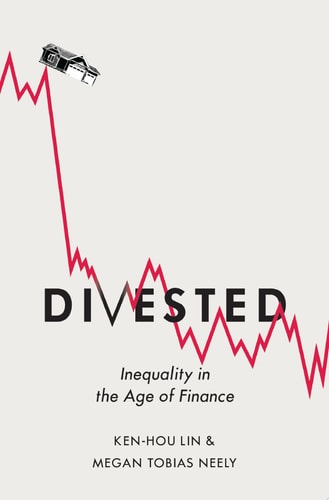
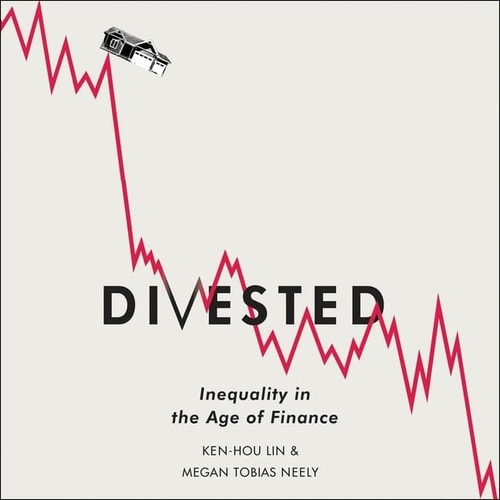
Divested: Inequality in the Age of Finance
0
0
As an Amazon Associate and affiliate partner, Menrva Books earns from qualifying purchases. Learn more
Author Description
Finance is an inescapable part of American life. From how one pursues an education, buys a home, runs a business, or saves for retirement, finance orders the lives of ordinary Americans. And as finance continues to expand, inequality soars. In Divested, Ken-Hou Lin and Megan Tobias Neely document how the ascendance of finance on Wall Street, Main Street, and among households is a fundamental cause of economic inequality. They argue that finance has reshaped the economy in three important ways. First, the financial sector extracts resources from the economy at large without providing commensurate economic benefits to those outside the financial services industry. Second, firms in other economic sectors have become increasingly involved in lending and speculative investing, which weakens the demand for labor and the bargaining power of workers. And third, the shift of risks and uncertainties once shouldered by unions, corporations, and governments onto families escalates the consumption of financial products, which in turns exacerbates wealth inequality. A clear, comprehensive, and convincing account of the forces driving economic inequality in America, Divested warns us that the most damaging consequence of the expanding financial system is not simply recurrent financial crises but a widening social divide between the have and have-nots.
Menrva's Summary
THE THESIS
How does the expansion of the financial sector contribute to the widening gap of economic inequality in the United States? Authors Ken-Hou Lin and Megan Tobias Neely, both sociologists, utilize extensive economic data and institutional analysis to argue that the financialization of the American economy is a primary driver of wealth disparity. They posit that the shift toward speculative investment and the transfer of financial risk from institutions to households have fundamentally altered the distribution of resources. The text provides a structural framework for understanding how finance permeates daily life, from education to retirement planning.
THE SCOPE MAP
What You Will Find
- Analysis of financial sector resource extraction from the broader economy
- Examination of non-financial firms engaging in speculative lending and investment
- Study of the transfer of economic risk from corporations and governments to individual families
- Evaluation of how financial product consumption exacerbates wealth gaps
Scope Limits
- Does not focus on individual financial literacy or personal investment advice
- Does not provide a comprehensive history of global financial markets outside the United States
THE AUTHORITY PERSPECTIVE
Experts in sociology and political economy recognize this work as a rigorous examination of the structural causes of modern inequality. Readers frequently note the academic density of the prose, which makes it a suitable resource for students and researchers interested in the intersection of finance and social stratification.
Page Count:
238
Publication Date:
2019-01-01
Publisher:
Oxford University Press
ISBN-10:
0190638338
ISBN-13:
9780190638337
Economics
English & College Success
American Studies
English
Sociology
Finance
Macroeconomic Theory
Comparative Politics
Community Tags
Other Editions(2)
Similar Books