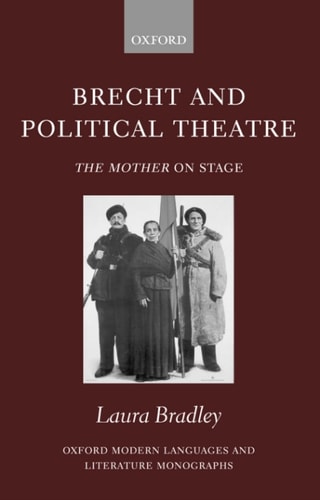
Brecht and Political Theatre: The Mother on Stage
0
0
As an Amazon Associate and affiliate partner, Menrva Books earns from qualifying purchases. Learn more
Author Description
This production history of The Mother provides substantial new insights into Bertolt Brecht's theatre and drama, his impact on political theatre, and the relationship between text, performance, and politico-cultural context. As the only play which Brecht staged in the Weimar Republic, during his exile, and in the GDR, The Mother offers a unique opportunity to compare his theatrical practice in contrasting settings and at different points in his career. Through detailed analysis of original archival evidence, Bradley shows how Brecht became far more sensitive to his spectators' political views and cultural expectations, even making major tactical concessions in his 1951 production at the Berliner Ensemble. These compromises indicate that his 'mature' staging should not be regarded as definitive, for it was tailored to a unique and delicate situation. The Mother has appealed strongly to politically committed theatre practitioners both in and beyond Germany. By exploiting the text's generic hybridity and the interplay between Brecht's 'epic' and 'dramatic' elements, directors have interpreted it in radically different ways. So although Brecht's 1951 production stagnated into an affirmative GDR heritage piece, post-Brechtian directors have used The Mother to promote their own political and theatrical concerns, from anti-authoritarian theatre to reflections on the legacies of state Socialism. Their ideological and theatrical subversion have helped Brecht's text to outlive the political system that it came to uphold.
Menrva's Summary
THE THESIS
This study investigates how Bertolt Brecht’s play The Mother functioned as a barometer for his evolving political and theatrical strategies across three distinct German political eras. Laura Bradley, a scholar of German theatre, utilizes extensive archival research and production history to argue that Brecht’s staging of the play was not a static, definitive work but a series of tactical adaptations. By examining the interplay between text and performance, the author demonstrates how Brecht adjusted his methods to navigate the shifting cultural expectations of the Weimar Republic, his period of exile, and the German Democratic Republic.
THE SCOPE MAP
What You Will Find
- A comparative analysis of Brecht’s theatrical practice across three different political regimes.
- Examination of the 1951 Berliner Ensemble production and its subsequent status as a GDR heritage piece.
- Analysis of the tension between epic and dramatic elements within the play’s structure.
- Discussion of post-Brechtian interpretations and their use of the text for anti-authoritarian critique.
Scope Limits
- The study focuses primarily on the production history of The Mother rather than a comprehensive biography of Brecht.
- It does not provide an exhaustive survey of all international adaptations, focusing instead on the German context.
THE AUTHORITY PERSPECTIVE
Experts recognize this monograph as a rigorous contribution to the field of German theatre studies, particularly for its meticulous use of archival evidence. Readers frequently note the academic density of the prose, which is tailored for scholars and students of political theatre and performance history.
Page Count:
280
Publication Date:
2006-01-01
Publisher:
Clarendon Press
ISBN-10:
0191536776
ISBN-13:
9780191536779
Non-Fiction
English & College Success
Political Aspects
Literary Criticism
Theatre studies
Criticism history
English
German history
Community Tags
Similar Books