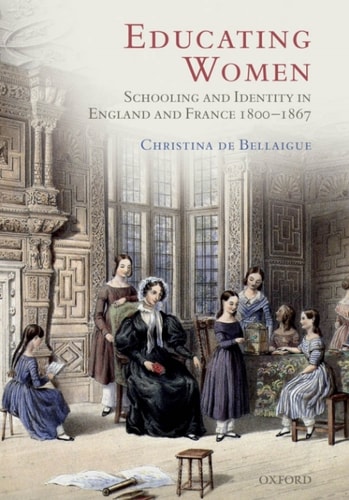
Educating Women: Schooling and Identity in England and France, 1800-1867
0
0
As an Amazon Associate and affiliate partner, Menrva Books earns from qualifying purchases. Learn more
Author Description
An increasing number of middle class families were taking the education of their daughters seriously in the first part of the nineteenth century, and boarding-schools were multiplying on both sides of the Channel. Schoolmistresses - rarely, in fact, the 'reduced gentlewomen' of nineteenth century fiction - were not only often successful entrepreneurs, but also played an important part they played in the development of the teaching profession, and in the expansion of secondary education. Uncovering their careers and the experiences of their pupils reveals the possibilities and constraints of the lives of middle class women in England and France in the period 1800-1867. Yet those who crossed the Channel in the nineteenth century often commented on the differences they discovered between the experiences of French and English women. Women in France seemed to participate more fully in social and cultural life than their counterparts in England. On the other hand, English girls were felt to enjoy considerably more freedom than young French women. Using the development of schooling for girls as a lens through which to examine the lives of women on either side of the Channel, Educating Women explores such contrasts. It reveals that the differences observed by contemporaries were rooted in the complex interaction of differing conceptions of the role of women with patterns of educational provision, with religion, with the state, and with differing rhythms of economic growth. Illuminating a neglected area of the history of education, it reveals new findings on the history of the professions, on the history of women and on the relationship between gender and national identity in the nineteenth century.
Menrva's Summary
THE THESIS
This book investigates how the development of girls' schooling in nineteenth-century England and France shaped the identities and social roles of middle-class women. Christina de Bellaigue, a historian specializing in nineteenth-century education and gender, utilizes archival records and contemporary accounts to compare the educational landscapes of both nations. She argues that the observed differences in women's lives were not merely cultural stereotypes but were deeply rooted in distinct national approaches to religion, state involvement, and economic development.
THE SCOPE MAP
What You Will Find
- Comparative analysis of boarding-school systems in England and France from 1800 to 1867.
- Examination of the professionalization of schoolmistresses as entrepreneurs.
- Analysis of the intersection between gender, national identity, and secondary education.
Scope Limits
- The study focuses primarily on the middle class and does not provide an exhaustive account of working-class or aristocratic education.
- The analysis is geographically restricted to England and France, excluding broader European educational trends.
THE AUTHORITY PERSPECTIVE
Historians and scholars of education recognize this work as a significant contribution to the comparative history of gender and schooling. Readers frequently note the academic rigor of the research and the clarity with which the author navigates complex socio-political differences between the two nations.
Page Count:
280
Publication Date:
2007-01-01
Publisher:
Oxford University Press
ISBN-10:
0191537306
ISBN-13:
9780191537301
History
Social History
Special Topics
Education
Women france
19th Century
Women
Womens History
European History
Community Tags
Similar Books