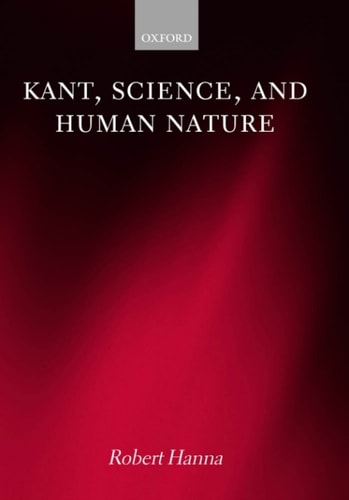
Kant, Science, and Human Nature
0
0
As an Amazon Associate and affiliate partner, Menrva Books earns from qualifying purchases. Learn more
Author Description
Robert Hanna argues for the importance of Kant's theories of the epistemological, metaphysical, and practical foundations of the 'exact sciences'--- relegated to the dustbin of the history of philosophy for most of the 20th century. Hanna's earlier book Kant and the Foundations of Analytic Philosophy (OUP 2001), explores basic conceptual and historical connections between Immanuel Kant's 18th-century Critical Philosophy and the tradition of mainstream analytic philosophy from Frege to Quine. The central topics of the analytic tradition in its early and middle periods were meaning and necessity. But the central theme of mainstream analytic philosophy after 1950 is scientific naturalism, which holds---to use Wilfrid Sellars's apt phrase---that 'science is the measure of all things'. This type of naturalism is explicitly reductive. Kant, Science, and Human Nature has two aims, one negative and one positive. Its negative aim is to develop a Kantian critique of scientific naturalism. But its positive and more fundamental aim is to work out the elements of a humane, realistic, and nonreductive Kantian account of the foundations of the exact sciences. According to this account, the essential properties of the natural world are directly knowable through human sense perception (empirical realism), and practical reason is both explanatorily and ontologically prior to theoretical reason (the primacy of the practical).
Menrva's Summary
THE THESIS
This book investigates whether a non-reductive, Kantian framework can provide a more robust foundation for the exact sciences than contemporary scientific naturalism. Robert Hanna, a philosopher specializing in Kantian studies and analytic philosophy, utilizes the framework of 18th-century Critical Philosophy to challenge the post-1950s consensus that science is the sole measure of reality. He argues that by prioritizing practical reason and empirical realism, one can construct a humane account of scientific foundations that avoids the reductive pitfalls of modern naturalism.
THE SCOPE MAP
What You Will Find
- A critical analysis of scientific naturalism from a Kantian perspective
- An exploration of the relationship between theoretical and practical reason
- A defense of empirical realism regarding human sense perception
- Historical connections between Kantian philosophy and the analytic tradition
Scope Limits
- The text does not provide a comprehensive history of all 20th-century analytic philosophy
- It does not attempt to resolve every technical debate within contemporary philosophy of science
THE AUTHORITY PERSPECTIVE
Scholars and students of Kantian philosophy frequently identify this work as a significant contribution to the dialogue between classical idealism and modern analytic naturalism. Experts note the high level of academic rigor and the density of the prose, making it a text primarily suited for advanced students and professional philosophers.
Page Count:
512
Publication Date:
2006-01-01
Publisher:
Clarendon Press
ISBN-10:
0191536539
ISBN-13:
9780191536533
Philosophy
Kant
Science Philosophy
Science
Metaphysics
History & Surveys
Philosophy history
Epistemology
Community Tags
Other Editions(4)

Similar Books

Reader Comments
Share Your Thoughts
No comments yet. Be the first to share your thoughts!