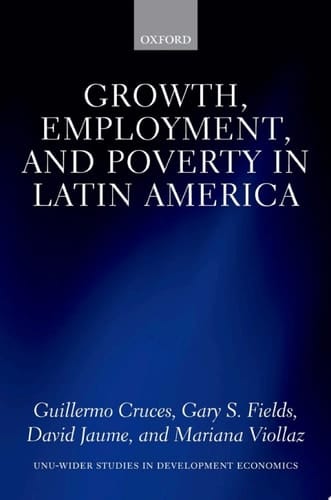
Growth, Inequality, and Poverty: Prospects for Pro-Poor Economic Development
0
0
Author Description
The relationship between growth, inequality, and poverty lies at the heart of development economics. This volume draws together many of the most important recent contributions to the controversies surrounding this topic. Some of the chapters help explain why there is profound disagreement on crucial issues of growth, poverty and inequality within academic circles, and among organizations and various groups active in the development field. Another central theme is the cross-country evidence on the relationship between growth and poverty, and the extent to which it is valid to draw policy conclusions from this empirical evidence. The volume also shows how new microeconomic techniques such as poverty maps and microsimulation models can be used to improve poverty analysis and the design of pro-poor policies. The overall conclusion points to the need for diverse strategies towards growth and poverty, rather than simple blanket policy rules. Initial conditions, specific country structures, and time horizons all play a significant role. Initial conditions affect the speed with which growth reduces poverty and can also determine whether policies such as trade liberalization have a pro-poor or an anti-poor outcome. Improved education is valuable in itself, and also contributes to poverty reduction; but its effect on inequality depends on supply and demand factors, which differ significantly across countries. Likewise, the quantitative impact on poverty of redistribution from the rich to the poor vis-à-vis an increase in total national income can vary greatly across countries. Hence the need for creative approaches to poverty which take full account of the specific circumstances of individual nations and which assign a central role to inequality analysis in the discussion of poverty-alleviation policies.
Menrva's Summary
THE THESIS
This volume investigates the complex, often contentious relationship between economic growth, income inequality, and poverty reduction strategies in developing nations. Edited by Anthony Shorrocks and Rolph van der Hoeven, the text synthesizes contemporary research and empirical evidence to challenge the efficacy of universal policy prescriptions. By examining diverse country-specific structures and initial conditions, the authors argue that effective poverty alleviation requires nuanced, context-dependent strategies rather than standardized economic models.
THE SCOPE MAP
What You Will Find
- Cross-country empirical evidence regarding the correlation between GDP growth and poverty reduction.
- Applications of microeconomic tools, including poverty mapping and microsimulation modeling.
- Analysis of how initial national conditions influence the outcomes of trade liberalization and education policies.
Scope Limits
- The text does not provide a singular, unified theory of development but rather a collection of diverse academic perspectives.
- It does not offer a universal policy manual, explicitly rejecting blanket rules in favor of localized strategies.
THE AUTHORITY PERSPECTIVE
Experts recognize this volume as a significant contribution to the WIDER Studies in Development Economics series, frequently citing its utility in bridging the gap between theoretical macroeconomics and practical policy design. Readers often note the academic density of the prose, which is tailored primarily for development economists, policy analysts, and graduate-level students.
Page Count:
304
Publication Date:
2004-01-01
Publisher:
Oxford University Press
ISBN-10:
0191533335
ISBN-13:
9780191533334
Economics
Macroeconomics
Poverty
Business Ethics
Community Tags
Similar Books