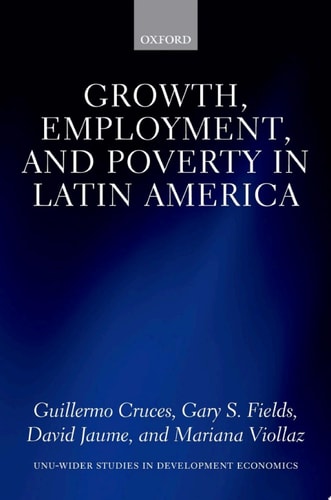
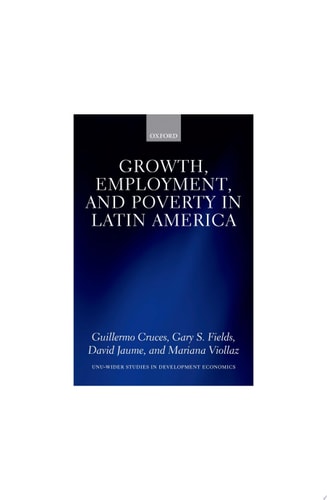
Growth, Employment, and Poverty in Latin America
0
0
As an Amazon Associate and affiliate partner, Menrva Books earns from qualifying purchases. Learn more
Author Description
This is an open access title available under the terms of a CC BY-NC-SA 3.0 IGO licence. It is free to read at Oxford Scholarship Online and offered as a free PDF download from OUP and selected open access locations. This book examines the links between economic growth, changing employment conditions, and the reduction of poverty in Latin America in the 2000s. Our analysis answers the following broad questions: Has economic growth resulted in gains in standards of living and reductions in poverty via improved labour market conditions in Latin America in the 2000s, and have these improvements halted or been reversed since the international crisis of 2008? How do the rate and character of economic growth, changes in the various employment and earnings indicators, and changes in poverty and inequality indicators relate to each other? Our contribution is an in-depth study of the multi-pronged growth-employment-poverty nexus based on a large number of labour market indicators (twelve employment and earnings indicators and four poverty and inequality indicators) for a large number of Latin American countries (sixteen of them). The book presents a positive and hopeful set of findings for the period 2000 to 2012/13. Economic growth took place and brought about improvements in almost all labour market indicators and consequent reductions in poverty rates. But not all improvements were equal in size or caused by the same things. Some macroeconomic factors were associated with changes in labour market conditions, some of them always in the welfare-improving direction and some others always in the welfare-reducing direction. Most countries in the region suffered a deterioration in at least some labour market indicators as a consequence of the international crisis of 2008, but the negative effects were reversed very quickly in most countries.
Menrva's Summary
THE THESIS
This book investigates whether economic growth in Latin America during the 2000s successfully translated into improved living standards and poverty reduction through labor market advancements. The authors, a team of expert economists, utilize a comprehensive dataset covering sixteen Latin American countries to analyze the complex nexus between macroeconomic growth, employment conditions, and poverty indicators. Their research framework evaluates the impact of the 2008 international financial crisis on these trends, providing a detailed assessment of how regional economic shifts influenced individual welfare.
THE SCOPE MAP
What You Will Find
- Analysis of twelve distinct employment and earnings indicators.
- Evaluation of four primary poverty and inequality metrics.
- Comparative study across sixteen Latin American nations from 2000 to 2013.
- Assessment of macroeconomic factors influencing labor market outcomes.
Scope Limits
- The study focuses primarily on the period between 2000 and 2013 and does not cover long-term structural changes post-2013.
- The analysis is restricted to the sixteen countries included in the WIDER dataset.
THE AUTHORITY PERSPECTIVE
Experts recognize this work as a rigorous empirical contribution to development economics, particularly for its systematic use of multi-country labor market data. Readers frequently note the academic density of the prose, which serves as a foundational reference for researchers studying regional economic development in the Global South.
Page Count:
512
Publication Date:
2017-01-01
Publisher:
OUP Oxford
ISBN-10:
0192521519
ISBN-13:
9780192521514
Economics
Poverty
American Studies
Economic Theory
Macroeconomics
Community Tags
Other Editions(2)
Similar Books











Reader Comments
Share Your Thoughts
No comments yet. Be the first to share your thoughts!