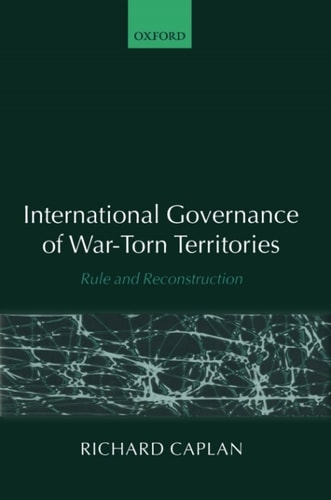
International Governance of War-Torn Territories: Rule and Reconstruction
0
0
As an Amazon Associate and affiliate partner, Menrva Books earns from qualifying purchases. Learn more
Author Description
Since the mid-1990s the United Nations and other multilateral organizations have been entrusted with exceptional authority for the administration of war-torn and strife-ridden territories. In Bosnia and Herzegovina, Eastern Slavonia, Kosovo, and East Timor these organizations have assumed responsibility for governance to a degree unprecedented in recent history. These initiatives represent some of the boldest experiments in the management and settlement of intra-state conflict ever attempted by third parties. This book is a study of recent experiences in the international administration of war-torn territories. It examines the nature of these operations - their mandates, structures, and powers - and distinguishes them from kindred historical and contemporary experiences of peacekeeping, trusteeship, and military occupation. It analyses and assesses the effectiveness of international administrations and discusses, in thematic fashion, the key operational and political challenges that arise in the context of these experiences. It also reflects on the policy implications of these experiences, recommending reforms or new approaches to the challenge posed by localized anarchy in a global context. It argues that, despite many of the problems arising from both the design and implementation of international administrations, international administration has generally made a positive contribution to the mitigation of conflict in the territories where they have been established, thus removing or reducing a threat to peace and helping to improve the lives of the vast majority of the territories' inhabitants. This major new work from a leading scholar provides the first comprehensive treatment of recent attempts at international governance of war-torn territories, and will be essential reading for anyone interested in peace-keeping operations and international administration.
Menrva's Summary
THE THESIS
This book investigates the efficacy and operational challenges of international administrations tasked with governing war-torn territories since the mid-1990s. Richard Caplan, a scholar in international relations, utilizes a comparative analysis of UN-led missions in regions such as Bosnia and Herzegovina, Kosovo, and East Timor to evaluate the success of third-party governance. He argues that while these administrative experiments face significant design and implementation hurdles, they have generally succeeded in mitigating conflict and improving local living conditions.
THE SCOPE MAP
What You Will Find
- Comparative analysis of international administrative mandates in Bosnia, Eastern Slavonia, Kosovo, and East Timor.
- Examination of the structural and political powers granted to multilateral organizations.
- Assessment of policy implications and recommendations for future international interventions.
Scope Limits
- The text does not provide an exhaustive historical account of all 20th-century military occupations.
- It focuses primarily on post-Cold War multilateral interventions rather than unilateral state-building efforts.
THE AUTHORITY PERSPECTIVE
Experts recognize this work as a foundational text for understanding the complexities of international state-building and post-conflict governance. Readers frequently note the academic rigor and the clarity with which the author navigates the intersection of international law and practical political administration.
Page Count:
302
Publication Date:
2005-01-01
Publisher:
Oxford University Press
ISBN-10:
0191532495
ISBN-13:
9780191532498
History
Peacekeeping
Governance
Conflict Resolution
International relations
Community Tags
Other Editions(2)

Similar Books






Reader Comments
Share Your Thoughts
No comments yet. Be the first to share your thoughts!