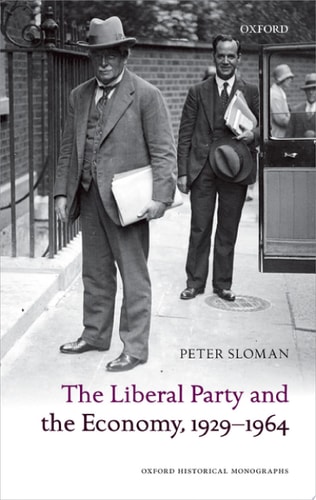
The Liberal Party and the Economy, 1929-1964
0
0
As an Amazon Associate and affiliate partner, Menrva Books earns from qualifying purchases. Learn more
Author Description
The Liberal Party and the Economy, 1929-1964 explores the reception, generation, and use of economic ideas in the British Liberal Party between its electoral decline in the 1920s and 1930s, and its post-war revival under Jo Grimond. Drawing on archival sources, party publications, and the press, this volume analyses the diverse intellectual influences which shaped British Liberals' economic thought up to the mid-twentieth century, and highlights the ways in which the party sought to reconcile its progressive identity with its longstanding commitment to free trade and competitive markets. Peter Sloman shows that Liberals' enthusiasm for public works and Keynesian economic management - which David Lloyd George launched onto the political agenda at the 1929 general election - was only intermittently matched by support for more detailed forms of state intervention and planning. Likewise, the party's support for redistributive taxation and social welfare provision was frequently qualified by the insistence that the ultimate Liberal aim was not the expansion of the functions of the state but the pursuit of 'ownership for all'. Liberal policy was thus shaped not only by the ideas of reformist intellectuals such as John Maynard Keynes and William Beveridge, but also by the libertarian and distributist concerns of Liberal activists and by interactions with the early neoliberal movement. This study concludes that it was ideological and generational changes in the early 1960s that cut the party's links with the New Right, opened up common ground with revisionist social democrats, and re-established its progressive credentials.
Menrva's Summary
THE THESIS
This book investigates how the British Liberal Party navigated the tension between its historical commitment to free trade and the rising demand for state-led economic management between 1929 and 1964. Peter Sloman, a historian specializing in British political thought, utilizes extensive archival research and party publications to map the evolution of Liberal economic ideology. He argues that the party's trajectory was defined by a complex interplay between Keynesian reformism, libertarian concerns, and the influence of early neoliberal thought, ultimately leading to a mid-century ideological shift.
THE SCOPE MAP
What You Will Find
- Analysis of economic policy shifts from the 1929 general election through the early 1960s.
- Examination of the intellectual contributions of figures such as John Maynard Keynes and William Beveridge.
- Investigation into the party's internal debates regarding redistributive taxation and state intervention.
Scope Limits
- The study does not provide a comprehensive history of the Liberal Party's electoral performance beyond its relation to economic policy.
- The analysis does not extend beyond the ideological realignments occurring in the early 1960s.
THE AUTHORITY PERSPECTIVE
Scholars recognize this work as a rigorous examination of the intellectual history of British liberalism during a period of significant political transition. Readers frequently note the academic density of the prose, which serves as a foundational text for understanding the evolution of mid-twentieth-century economic policy.
Page Count:
304
Publication Date:
2014-01-01
Publisher:
OUP Oxford
ISBN-10:
0191035262
ISBN-13:
9780191035265
Economics
History
British History
European History
20th Century
Liberalism