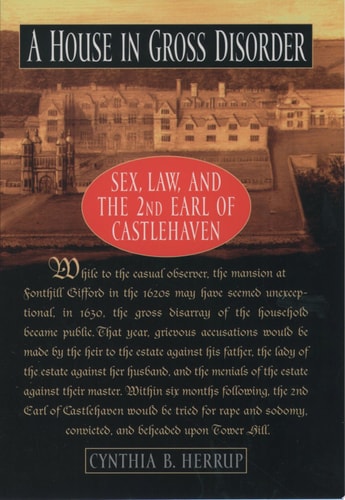
A House in Gross Disorder: Sex, Law, and the 2nd Earl of Castlehaven
0
0
As an Amazon Associate and affiliate partner, Menrva Books earns from qualifying purchases. Learn more
Author Description
Sex, privilege, corruption, and revenge--these are elements that we expect to find splashed across today's tabloid headlines. But 17th century England saw a sex scandal that brought disgrace to the ruling class and ended with the beheading of an earl. In A House in Gross Disorder, Cynthia Herrup presents a strikingly new interpretation of the case of the 2nd Earl of Castlehaven and of the sexual and social anxieties it cast into such bold relief. Castlehaven was convicted of assisting in the rape of his own wife and of committing sodomy with his servants. But more than that, he stood accused of inverting the natural order of his household by reveling in rather than restraining the intemperate passions of those he was expected to rule and protect. Herrup argues that because an orderly house was considered both an example and endorsement of aristocratic governance, the riotousness presided over by Castlehaven was the most damning evidence against him. Avoiding simple conclusions about guilt or innocence, Herrup focuses instead on the fascinating legal, social and political dynamics of the case and its subsequent retellings. In riveting prose, she reconsiders a scandal that still speaks to contemporary anxieties about sex, good governance, and the role of law in regulating both.
Menrva's Summary
THE THESIS
This book investigates how the 1631 trial of the 2nd Earl of Castlehaven for rape and sodomy functioned as a critical case study for 17th-century anxieties regarding aristocratic governance and the regulation of private morality. Cynthia B. Herrup, a professor of history and law, utilizes primary court records, pamphlets, and contemporary correspondence to reconstruct the scandal. She argues that the Earl's conviction was driven less by the specific sexual acts themselves and more by his failure to maintain the 'orderly house' expected of a nobleman, which served as a microcosm for the stability of the state.
THE SCOPE MAP
What You Will Find
- Analysis of 17th-century English legal proceedings and the intersection of domestic and public law.
- Examination of the social expectations placed upon the aristocracy regarding household management.
- Exploration of how the scandal was interpreted and retold in contemporary political discourse.
Scope Limits
- The book does not attempt to definitively prove the factual guilt or innocence of the Earl based on modern forensic standards.
- It does not provide a comprehensive biography of the Earl outside of the context of the scandal and his trial.
THE AUTHORITY PERSPECTIVE
Historians and legal scholars frequently cite this work for its nuanced approach to the relationship between private conduct and public authority in early modern England. Experts highlight the text as a sophisticated analysis that avoids sensationalism while providing significant insight into the political culture of the period.
Page Count:
216
Publication Date:
1999-01-01
Publisher:
Oxford University Press
ISBN-10:
0190284250
ISBN-13:
9780190284251
History
True Crime
Social History
Legal History
Professional Career & Trade
Gender Studies
European History
British History