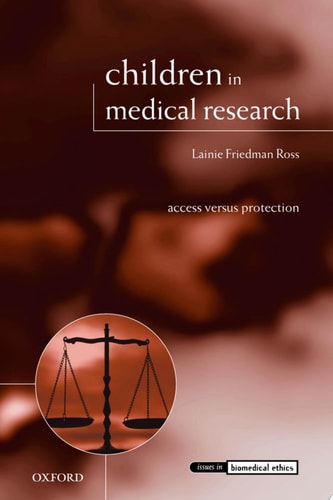
Children in Medical Research: Access versus Protection
0
0
As an Amazon Associate and affiliate partner, Menrva Books earns from qualifying purchases. Learn more
Author Description
Lainie Ross presents a rigorous critical investigation of the development of policy governing the involvement of children in medical research. She examines the shift in focus from protection of medical research subjects, enshrined in post-World War II legislation, to the current era in which access is assuming greater precedence. Infamous studies such as Willowbrook (where mentally retarded children were infected with hepatitis) are evidence that before the policy shift protection was not always adequate, even for the most vulnerable groups. Additional safeguards for children were first implemented in many countries in the 1970s and 1980s; more recent policies and guidelines are trying to promote greater participation. Ross considers whether the safeguards work, whether they are fair, and how they apply in actual research practice. She goes on to offer specific recommendations to modify current policies and guidelines. Ross examines the regulatory structures (e.g. federal regulations and institutional review boards), the ad hoc policies (e.g. payment in pediatric research and the role of schools as research venues), the actual practices of researchers (e.g. the race/ethnicity of enrolled research subjects or the decision to enroll newborns) as well as the decision-making process (both parental permission and the child's assent), in order to provide a broad critique. Some of her recommendations will break down current barriers to the enrolment of children (e.g. permitting the payment of child research subjects; allowing healthy children to be exposed to research that entails more than minimal risk without requiring recourse to 407 panels); whereas other recommendations may create new restrictions (e.g., the need for greater protection for research performed in schools; restrictions on what research should be done in the newborn nursery). The goal is to ensure that medical research is done in a way that promotes the health of current and future children without threat
Menrva's Summary
THE THESIS
This book investigates the ethical tension between protecting children from harm in medical research and ensuring they have equitable access to the benefits of clinical advancements. Author Lainie Friedman Ross, a scholar in pediatric ethics, utilizes historical case studies and an analysis of regulatory frameworks to argue that current policies often fail to balance these competing interests effectively. She proposes a revised policy structure designed to improve research integrity while safeguarding the rights of pediatric subjects.
THE SCOPE MAP
What You Will Find
- Historical analysis of post-World War II research regulations.
- Evaluation of institutional review board (IRB) efficacy and federal oversight.
- Examination of parental permission and child assent protocols.
- Case studies on specific research environments, including schools and newborn nurseries.
Scope Limits
- The text focuses primarily on the United States regulatory environment.
- It does not provide a comprehensive global survey of pediatric research laws outside of Western frameworks.
THE AUTHORITY PERSPECTIVE
Experts in the field of bioethics identify this work as a foundational text for understanding the evolution of pediatric research policy. Readers frequently note the academic density of the prose, which provides a thorough and rigorous examination of complex regulatory challenges.
Page Count:
304
Publication Date:
2008-01-01
Publisher:
Oxford University Press
ISBN-10:
0191534218
ISBN-13:
9780191534218
Philosophy
Pediatrics
Public Policy
Medical Ethics
Medical policy
Medicine
Bioethics
Community Tags
Similar Books