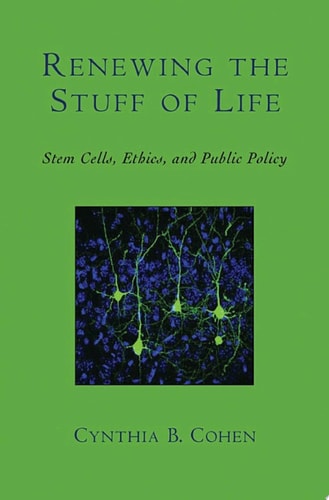
Renewing the Stuff of Life: Stem Cells, Ethics, and Public Policy
0
0
As an Amazon Associate and affiliate partner, Menrva Books earns from qualifying purchases. Learn more
Author Description
Stem cell therapy is ushering in a new era of medicine in which we will be able to repair human organs and tissue at their most fundamental level- that of the cell. The power of stem cells to regenerate cells of specific types, such as heart, liver, and muscle, is unique and extraordinary. In 1998 researchers learned how to isolate and culture embryonic stem cells, which are only obtainable through the destruction of human embryos. An ethical debate has raged since then about the ethics of this research, usually pitting pro-life advocates vs. those who see the great promise of curing some of humanity's most persistent diseases. In this book Cynthia Cohen agrees that we need to work toward a consensus on the issue of how we treat the embryo. But more broadly she claims that we need to transform and expand the ethical and policy debates on stem cells (adult and embryonic). This important and much-needed book is both a primer and a means by which to understand the implications of this research. Cohen starts by introducing readers to the basic science of stem cell research, and the core ethical questions surrounding the embryo. She then expands the scope of the debate, looking at the moral questions that will crop up down the line, such as e.g. the use of therapeutic cloning to overcome the body's immune resistance to stem cells; the ethics of using animals to test stem cells; how to disentangle federal and state legal and regulatory policies in pursuit of a coherent national policy; and how to develop an ethics of stem cell research that will accommodate new techniques and controversies that we cannot even foresee now. Her final chapter develops a concrete plan for an oversight system for this research. This is the first single-author book that addresses the many broad ethical and legal issues related to stem cells, and it should be of great interest to bioethicists, researchers, clinicians, philosophers, theologians, lawyers, policy makers, and general readers.
Menrva's Summary
THE THESIS
This book investigates the complex ethical and regulatory challenges posed by stem cell research, arguing for a comprehensive framework that transcends the narrow focus on embryonic status. Cynthia B. Cohen, a noted bioethicist, utilizes her expertise to synthesize the scientific potential of regenerative medicine with the moral dilemmas inherent in its development. She proposes a structured approach to policy that balances medical advancement with societal values, aiming to move beyond the binary conflicts that have historically stalled progress in the field.
THE SCOPE MAP
What You Will Find
- An introduction to the biological mechanisms of adult and embryonic stem cells
- Analysis of therapeutic cloning and immune resistance challenges
- Ethical considerations regarding animal testing in regenerative medicine
- A proposed oversight system for national regulatory policy
Scope Limits
- The text does not provide a technical manual for laboratory procedures
- It does not offer a definitive resolution to the philosophical status of the human embryo
THE AUTHORITY PERSPECTIVE
Experts and bioethicists recognize this work as a foundational text for understanding the intersection of science and public policy. Readers frequently note the clarity of the prose, which makes complex ethical arguments accessible to both professionals and the general public.
Page Count:
317
Publication Date:
2007-01-01
Publisher:
Oxford University Press
ISBN-10:
0190294027
ISBN-13:
9780190294021
Philosophy
Medical Ethics
Science Policy
Bioethics
Allied Health
Medical
Public Policy
STEM Cells
Stem Cell Research
Community Tags
Similar Books