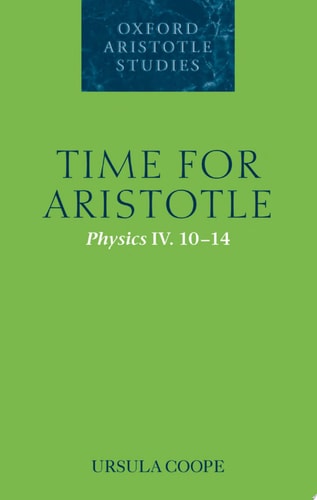
Time for Aristotle
0
0
As an Amazon Associate and affiliate partner, Menrva Books earns from qualifying purchases. Learn more
Author Description
What is the relation between time and change? Does time depend on the mind? Is the present always the same or is it always different? Aristotle tackles these questions in the Physics, and Time for Aristotle is the first book in English devoted to this discussion. Aristotle claims that time is not a kind of change, but that it is something dependent on change; he defines it as a kind of 'number of change'. Ursula Coope argues that what this means is that time is a kind of order (not, as is commonly supposed, a kind of measure). It is universal order within which all changes are related to each other. This interpretation enables Coope to explain two puzzling claims that Aristotle makes: that the now is like a moving thing, and that time depends for its existence on the mind. Brilliantly lucid in its explanation of this challenging section of the Physics, Time for Aristotle shows his discussion to be of enduring philosophical interest.
Menrva's Summary
THE THESIS
This book investigates the fundamental nature of time as presented in Aristotle's Physics, specifically addressing the relationship between time, change, and the human mind. Ursula Coope, a scholar of ancient philosophy, provides a rigorous analysis of Aristotle's definition of time as a 'number of change.' She challenges traditional interpretations by arguing that Aristotle views time as a universal order rather than a mere measure, offering a new framework to resolve long-standing paradoxes regarding the 'now' and the role of the mind in time's existence.
THE SCOPE MAP
What You Will Find
- A detailed philosophical analysis of Aristotle's Physics, Book IV
- A re-evaluation of the concept of time as a 'number of change'
- A systematic explanation of the relationship between time and change
- Arguments regarding the mind-dependence of time
Scope Limits
- The text focuses primarily on Aristotle's specific arguments in the Physics and does not provide a comprehensive history of time in ancient Greek thought.
THE AUTHORITY PERSPECTIVE
Scholars and students of ancient philosophy frequently cite this work for its clarity in navigating the technical complexities of Aristotelian metaphysics. It is widely regarded as a foundational text for those seeking to understand the specific nuances of Aristotle's temporal theories.
Page Count:
202
Publication Date:
2005-01-01
Publisher:
Clarendon Press
ISBN-10:
0191530123
ISBN-13:
9780191530128
Philosophy
History & Surveys
Physics
Metaphysics
Community Tags
Similar Books