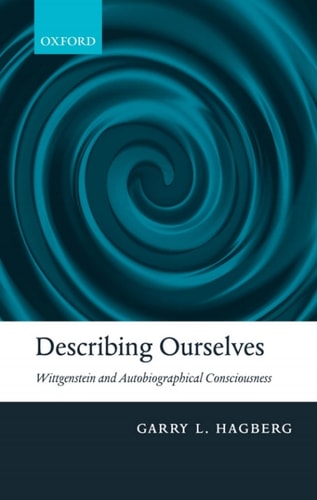
Describing Ourselves: Wittgenstein and Autobiographical Consciousness
0
0
As an Amazon Associate and affiliate partner, Menrva Books earns from qualifying purchases. Learn more
Author Description
The voluminous writings of Ludwig Wittgenstein contain some of the most profound reflections of recent times on the nature of the human subject and self-understanding - the human condition, philosophically speaking. Describing Ourselves mines those extensive writings for a conception of the self that stands in striking contrast to its predecessors as well as its more recent alternatives. More specifically, the book offers a detailed discussion of Wittgenstein's later writings on language and mind as they hold special significance for the understanding and clarification of the distinctive character of self-descriptive or autobiographical language. Garry L. Hagberg undertakes a ground-breaking philosophical investigation of selected autobiographical writings - among the best examples we have of human selves exploring themselves - as they cast new and special light on the critique of mind-body dualism and its undercurrents in particular and on the nature of autobiographical consciousness more generally. The chapters take up in turn the topics of self-consciousness, what Wittgenstein calls 'the inner picture', mental privacy and the picture of metaphysical seclusion, the very idea of our observation of the contents of consciousness, first-person expressive speech, reflexive or self-directed thought and competing pictures of introspection, the nuances of retrospective self-understanding, person-perception and the corollary issues of self-perception (itself an interestingly dangerous phrase), self-defining memory, and the therapeutic conception of philosophical progress as it applies to all of these issues. The cast of characters interwoven throughout this rich discussion include, in addition to Wittgenstein centrally, Augustine, Goethe, Dostoevsky, Kierkegaard, Iris Murdoch, Donald Davidson, and Stanley Cavell, among others. Throughout, conceptual clarifications concerning mind and language are put to work in the investigation of issues relating to self-description and i
Menrva's Summary
THE THESIS
This book investigates how Ludwig Wittgenstein’s later philosophy of language and mind provides a framework for understanding the nature of autobiographical consciousness and self-description. Garry L. Hagberg, a scholar of philosophy, utilizes Wittgenstein’s critiques of mind-body dualism to re-examine how individuals articulate their own identities. By synthesizing Wittgenstein’s complex linguistic theories with classic autobiographical texts, the author argues that self-understanding is not a private mental act but a process deeply embedded in language and social context.
THE SCOPE MAP
What You Will Find
- Analysis of Wittgenstein’s later writings on mental privacy and the 'inner picture'.
- Philosophical examination of self-consciousness, memory, and person-perception.
- Comparative studies involving thinkers such as Augustine, Kierkegaard, Iris Murdoch, and Stanley Cavell.
Scope Limits
- The text does not provide a comprehensive biography of Wittgenstein himself.
- It does not offer a general guide to writing autobiography, focusing instead on the philosophical underpinnings of the act.
THE AUTHORITY PERSPECTIVE
Scholars and students of analytic philosophy frequently note the high level of academic density in Hagberg’s prose. Experts highlight this work as a significant contribution to the intersection of philosophy of mind and literary theory, particularly for those interested in the application of Wittgensteinian concepts to the study of the self.
Page Count:
288
Publication Date:
2008-01-01
Publisher:
Oxford University Press
ISBN-10:
0191552860
ISBN-13:
9780191552861
Autobiography
Philosophy
Epistemology
Language
Mind & Body
Wittgenstein
Self Philosophy
Community Tags
Similar Books