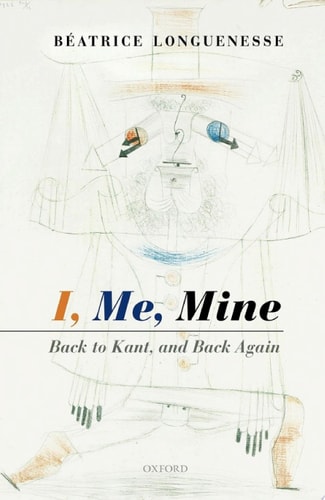
I, Me, Mine: Back to Kant, and Back Again
0
0
As an Amazon Associate and affiliate partner, Menrva Books earns from qualifying purchases. Learn more
Author Description
Béatrice Longuenesse presents an original exploration of our understanding of ourselves and the way we talk about ourselves. In the first part of the book she discusses contemporary analyses of our use of 'I' in language and thought, and compares them to Kant's account of self-consciousness, especially the type of self-consciousness expressed in the proposition 'I think.' According to many contemporary philosophers, necessarily, any instance of our use of 'I' is backed by our consciousness of our own body. For Kant, in contrast, 'I think' just expresses our consciousness of being engaged in bringing rational unity into the contents of our mental states. In the second part of the book, Longuenesse analyzes the details of Kant's view and argues that contemporary discussions in philosophy and psychology stand to benefit from Kant's insights into self-consciousness and the unity of consciousness. The third and final part of the book outlines similarities between Kant's view of the structure of mental life grounding our uses of 'I' in 'I think' and in the moral 'I ought to,' on the one hand; and Freud's analysis of the organizations of mental processes he calls 'ego' and 'superego' on the other hand. Longuenesse argues that Freudian metapsychology offers a path to a naturalization of Kant's transcendental view of the mind. It offers a developmental account of the normative capacities that ground our uses of 'I,' which Kant thought could not be accounted for without appealing to a world of pure intelligences, distinct from the empirical, natural world of physical entities.
Menrva's Summary
THE THESIS
How does the linguistic and cognitive use of the first-person pronoun 'I' relate to the structure of self-consciousness and the unity of mental life? Béatrice Longuenesse, a prominent scholar of Kantian philosophy, investigates the intersection of contemporary analytic philosophy, Kantian transcendental idealism, and Freudian psychoanalysis. She argues that modern psychological and philosophical accounts of self-consciousness are enriched by integrating Kant's framework regarding the rational unity of mental states. By bridging these disparate fields, the author proposes a developmental model that grounds normative self-reference in both cognitive and moral contexts.
THE SCOPE MAP
What You Will Find
- Comparative analysis of contemporary 'I' usage versus Kantian 'I think' propositions
- Examination of the relationship between bodily consciousness and rational self-consciousness
- Theoretical synthesis of Kantian transcendental structures with Freudian ego and superego models
- Discussion on the naturalization of normative mental capacities
Scope Limits
- Does not provide a comprehensive history of all theories of the self
- Does not focus on empirical neuroscientific data regarding self-awareness
THE AUTHORITY PERSPECTIVE
Scholars frequently note the high academic density of the prose, which requires a strong background in Kantian studies to fully navigate. Experts highlight this work as a significant contribution to the ongoing dialogue between classical transcendental philosophy and modern psychological theory.
Page Count:
288
Publication Date:
2017-01-01
Publisher:
OUP Oxford
ISBN-10:
0192514334
ISBN-13:
9780192514332
Philosophy
Kant
Epistemology
Psychoanalysis
Self
Self Philosophy
Metaphysics
Mind & Body
Community Tags
Similar Books