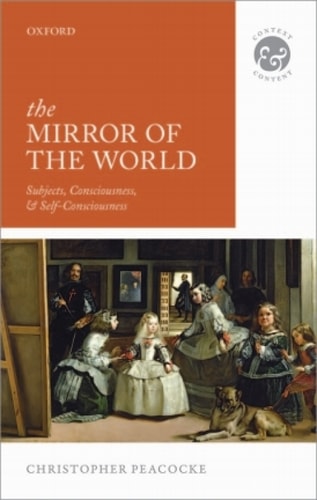
The Mirror of the World: Subjects, Consciousness, and Self-Consciousness
0
0
As an Amazon Associate and affiliate partner, Menrva Books earns from qualifying purchases. Learn more
Author Description
Christopher Peacocke presents a philosophical theory of subjects of consciousness, together with a theory of the nature of first person representation of such a subject of consciousness. He develops a new treatment of subjects, distinct from previous theories, under which subjects were regarded either as constructs from mental events, or fundamentally embodied, or Cartesian egos. In contrast, his theory of the first person integrates with the positive treatment of subjects—and it contributes to the explanation of various distinctive first person phenomena in the theory of thought and knowledge. These are issues on which contributions have been made by some of the greatest philosophers, and Peacocke brings his points to bear on the contributions to these issues made by Hume, Kant, Frege, Wittgenstein, and Strawson. He also relates his position to the recent literature in the philosophy of mind, and then goes on to distinguish and characterize three varieties of self-consciousness. Perspectival self-consciousness involves the subject's capacity to appreciate that she is of the same kind as things given in a third personal way, and attributes the subject to a certain kind of objective thought about herself. Reflective self-consciousness involves awareness of the subject's own mental states, reached in a distinctive way. Interpersonal self-consciousness is awareness that one features, as a subject, in some other person's mental states. These varieties, and the relations and the forms of co-operation between them, are important in explaining features of our knowledge, our social relations, and our emotional lives. The theses of The Mirror of the World are of importance not only for philosophy, but also for psychology, the arts, and anywhere else that the self and self-representation loom large. The Context and Content series is a forum for outstanding original research at the intersection of philosophy, linguistics, and cognitive science. The general editor is François Recanati.
Menrva's Summary
THE THESIS
This work investigates the fundamental nature of subjects of consciousness and the mechanisms underlying first-person representation. Christopher Peacocke, a prominent philosopher of mind, synthesizes historical perspectives from thinkers like Kant and Wittgenstein with contemporary cognitive science to propose a novel theory of the self. He argues that subjects are neither mere constructs of mental events nor purely Cartesian egos, but entities whose self-consciousness manifests through distinct, interrelated varieties.
THE SCOPE MAP
What You Will Find
- A tripartite framework of self-consciousness: perspectival, reflective, and interpersonal.
- A critical analysis of historical philosophical treatments of the self, including Hume, Frege, and Strawson.
- An integration of philosophical theory with psychological and cognitive science perspectives.
Scope Limits
- The text does not provide a comprehensive history of all theories of consciousness.
- It does not focus on neurobiological mechanisms, prioritizing conceptual and logical analysis over empirical brain science.
THE AUTHORITY PERSPECTIVE
Scholars and students of philosophy frequently note the high level of academic density and rigorous logical structure within the prose. Experts recognize this text as a significant contribution to the philosophy of mind, particularly for its attempt to bridge classical metaphysical questions with modern cognitive research.
Page Count:
295
Publication Date:
2014-01-01
Publisher:
OUP Oxford
ISBN-10:
0191502146
ISBN-13:
9780191502149
Philosophy
Mind & Body
Metaphysics
Philosophy of
Epistemology
Community Tags
Other Editions(2)
Similar Books

Reader Comments
Share Your Thoughts
No comments yet. Be the first to share your thoughts!