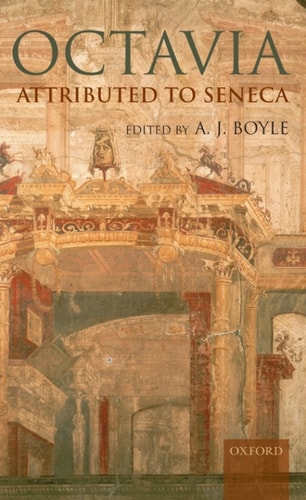
Octavia
0
0
As an Amazon Associate and affiliate partner, Menrva Books earns from qualifying purchases. Learn more
Author Description
Octavia is a work of exceptional historical and dramatic interest. It is the only surviving complete example of the Roman historical drama known as the fabula praetexta. Written shortly after Nero's death by an unknown author, the play deals with events at the court of Nero in the decisive year 62 CE, for which it is the earliest extant (almost contemporary) literary source; its main themes are sex, murder, politics, power and the perceptions and constructions of history. It is a powerful, lyrical and spectacular play. This is the first critical edition of Octavia, with verse translation and commentary, which aims to elucidate the text dramatically as well as philologically, and to locate it firmly in its historical and theatrical context. The verse translation is designed for both performance and serious study.
Menrva's Summary
THE PULSE
The play centers on the political and personal turmoil surrounding the forced divorce and eventual execution of Octavia, the wife of the Roman Emperor Nero. The protagonist, Octavia, struggles against the machinations of Nero and his inner circle, who seek to replace her with Poppaea Sabina. The narrative unfolds through a series of dialogues and monologues that explore the constraints of imperial power and the fragility of life within the Roman court. The play utilizes a classical dramatic framework, emphasizing the tension between private suffering and public political necessity.
INSIDE THE PAGES
- Historical drama based on the events of 62 CE
- Use of the fabula praetexta genre
- Exploration of power dynamics within the Neronian court
- Lyrical verse structure
- Focus on the themes of political intrigue and dynastic instability
- Inclusion of choral odes to provide commentary on the action
- Examination of the construction of historical narratives
- Critical edition format with verse translation and commentary
THE COLLECTIVE ECHO
Discussion often centers on the unique status of this work as the only surviving complete Roman historical drama. Readers frequently highlight the play's significance as a near-contemporary source for the events surrounding Nero's reign. Critics often analyze the balance between the dramatic portrayal of Octavia's plight and the underlying political commentary regarding the nature of tyranny. The text is widely studied for its philological depth and its effectiveness in capturing the atmosphere of the imperial court. Scholars and readers alike appreciate the inclusion of commentary that helps contextualize the theatrical and historical elements of the piece.
Page Count:
420
Publication Date:
2008-01-01
Publisher:
Oxford University Press
ISBN-10:
0191558354
ISBN-13:
9780191558351
Drama
English
Humanities
Plays
Tragedy
Classical
Dramatic works
Roman History
Theatre
English & College Success
Special Topics
Community Tags
Similar Books