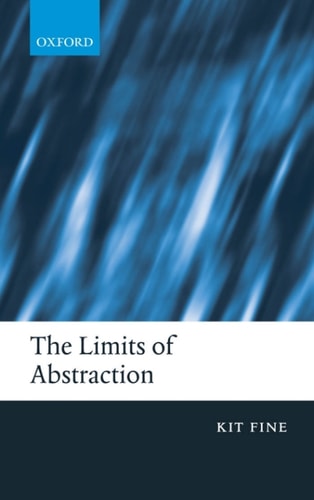
The Limits of Abstraction
0
0
As an Amazon Associate and affiliate partner, Menrva Books earns from qualifying purchases. Learn more
Author Description
What is abstraction? To what extent can it account for the existence and identity of abstract objects? And to what extent can it be used as a foundation for mathematics? Kit Fine provides rigorous and systematic answers to these questions along the lines proposed by Frege, in a book concerned both with the technical development of the subject and with its philosophical underpinnings. Fine proposes an account of what it is for a principle of abstraction to be acceptable, and these acceptable principles are exactly characterized. A formal theory of abstraction is developed and shown to be capable of providing a foundation for both arithmetic and analysis. Fine argues that the usual attempts to see principles of abstraction as forms of stipulative definition have been largely unsuccessful but that there may be other, more promising ways of vindicating the various forms of contextual definition. The Limits of Abstraction breaks new ground both technically and philosophically, and is essential reading for all those working on the philosophy of mathematics.
Menrva's Summary
THE THESIS
This book investigates the nature of abstraction and its capacity to serve as a foundational basis for mathematical systems. Kit Fine, a prominent philosopher of logic and language, utilizes a Fregean framework to evaluate the validity of abstraction principles. He argues that while traditional stipulative definitions have failed, alternative methods of contextual definition offer a more robust path for grounding arithmetic and analysis.
THE SCOPE MAP
What You Will Find
- A formal theory of abstraction principles
- Mathematical foundations for arithmetic and analysis
- Criteria for determining the acceptability of abstraction principles
- Critical analysis of Fregean logicist approaches
Scope Limits
- The text does not provide an introductory overview for those without a background in formal logic
- It does not explore non-Western or alternative non-Fregean philosophical traditions
THE AUTHORITY PERSPECTIVE
Experts recognize this work as a rigorous contribution to the philosophy of mathematics that demands significant technical proficiency from the reader. Scholars frequently note the density of the prose and the high level of formalization required to follow Fine's arguments.
Page Count:
213
Publication Date:
2002-01-01
Publisher:
OUP Oxford
ISBN-10:
0191567264
ISBN-13:
9780191567261
Philosophy
Logic
Logic & Critical Reasoning
Philosophy of
Abstraction
Metaphysics
Mathematics
Community Tags
Similar Books