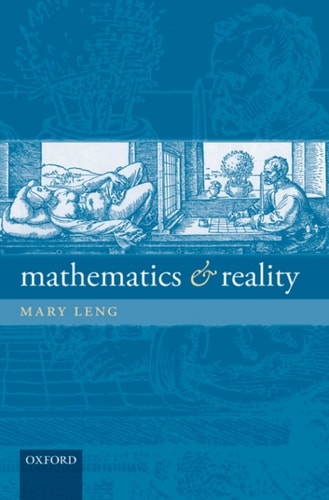
Mathematics and Reality
0
0
As an Amazon Associate and affiliate partner, Menrva Books earns from qualifying purchases. Learn more
Author Description
Mary Leng offers a defense of mathematical fictionalism, according to which we have no reason to believe that there are any mathematical objects. Perhaps the most pressing challenge to mathematical fictionalism is the indispensability argument for the truth of our mathematical theories (and therefore for the existence of the mathematical objects posited by those theories). According to this argument, if we have reason to believe anything, we have reason to believe that the claims of our best empirical theories are (at least approximately) true. But since claims whose truth would require the existence of mathematical objects are indispensable in formulating our best empirical theories, it follows that we have good reason to believe in the mathematical objects posited by those mathematical theories used in empirical science, and therefore to believe that the mathematical theories utilized in empirical science are true. Previous responses to the indispensability argument have focussed on arguing that mathematical assumptions can be dispensed with in formulating our empirical theories. Leng, by contrast, offers an account of the role of mathematics in empirical science according to which the successful use of mathematics in formulating our empirical theories need not rely on the truth of the mathematics utilized.
Menrva's Summary
THE THESIS
Does the indispensability of mathematics in empirical science necessitate a commitment to the existence of mathematical objects? Mary Leng, a philosopher specializing in the philosophy of mathematics, challenges the traditional indispensability argument by proposing a form of mathematical fictionalism. She argues that while mathematics is essential for scientific practice, this utility does not require the ontological assumption that mathematical entities actually exist.
THE SCOPE MAP
What You Will Find
- Analysis of the indispensability argument in the philosophy of science
- A defense of mathematical fictionalism as a viable ontological position
- Examination of the relationship between empirical theory and mathematical truth
Scope Limits
- The text does not provide a comprehensive history of mathematical logic
- The work focuses primarily on ontological questions rather than pedagogical applications of mathematics
THE AUTHORITY PERSPECTIVE
Scholars in the philosophy of mathematics recognize this work as a significant contribution to the debate surrounding mathematical realism and nominalism. Readers frequently note the academic density of the prose, which is intended for an audience familiar with analytic philosophy and formal logic.
Page Count:
256
Publication Date:
2010-01-01
Publisher:
OUP Oxford
ISBN-10:
0191576247
ISBN-13:
9780191576249
Philosophy
Mathematics
Metaphysics
Epistemology
Philosophy of
Logic & Critical Reasoning
Community Tags
Other Editions(3)
Similar Books