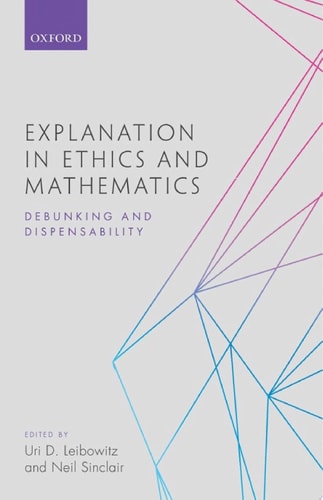
Explanation in Ethics and Mathematics: Debunking and Dispensability
0
0
As an Amazon Associate and affiliate partner, Menrva Books earns from qualifying purchases. Learn more
Author Description
How far should our realism extend? For many years philosophers of mathematics and philosophers of ethics have worked independently to address the question of how best to understand the entities apparently referred to by mathematical and ethical talk. But the similarities between their endeavours are not often emphasised. This book provides that emphasis. In particular, it focuses on two types of argumentative strategies that have been deployed in both areas. The first—debunking arguments—aims to put pressure on realism by emphasising the seeming redundancy of mathematical or moral entities when it comes to explaining our judgements. In the moral realm this challenge has been made by Gilbert Harman and Sharon Street; in the mathematical realm it is known as the 'Benacerraf-Field' problem. The second strategy—indispensability arguments—aims to provide support for realism by emphasising the seeming intellectual indispensability of mathematical or moral entities, for example when constructing good explanatory theories. This strategy is associated with Quine and Putnam in mathematics and with Nicholas Sturgeon and David Enoch in ethics. Explanation in Ethics and Mathematics addresses these issues through an explicitly comparative methodology which we call the 'companions in illumination' approach. By considering how argumentative strategies in the philosophy of mathematics might apply to the philosophy of ethics, and vice versa, the papers collected here break new ground in both areas. For good measure, two further companions for illumination are also broached: the philosophy of chance and the philosophy of religion. Collectively, these comparisons light up new questions, arguments, and problems of interest to scholars interested in realism in any area.
Menrva's Summary
THE THESIS
This book investigates the extent to which realism in ethics and mathematics can be justified by comparing the argumentative strategies used in both fields. The authors, Neil Sinclair and Uri D. Leibowitz, utilize a comparative methodology termed the 'companions in illumination' approach to analyze how debates regarding the existence of mathematical and moral entities mirror one another. By synthesizing arguments from prominent philosophers such as Quine, Putnam, Harman, and Street, the text evaluates whether these entities are redundant or indispensable to our explanatory theories.
THE SCOPE MAP
What You Will Find
- Comparative analysis of debunking arguments in moral and mathematical philosophy
- Examination of indispensability arguments for realism
- Application of the 'companions in illumination' methodology
- Extensions into the philosophy of chance and the philosophy of religion
Scope Limits
- Does not provide a definitive resolution to the realism debate
- Does not cover non-analytic approaches to moral or mathematical ontology
THE AUTHORITY PERSPECTIVE
Scholars in the field recognize this work as a significant contribution to meta-ethics and the philosophy of mathematics due to its unique comparative framework. Readers frequently note the academic density of the prose, which is intended for an audience already familiar with contemporary analytic philosophy.
Page Count:
267
Publication Date:
2016-01-01
Publisher:
OUP Oxford
ISBN-10:
0191084263
ISBN-13:
9780191084263
Philosophy
Metaphysics
Ethics
Mathematics Statistics
Post-Calculus
Mathematics
Philosophy of
Epistemology
Logic & Critical Reasoning
Community Tags
Other Editions(2)
Similar Books





Reader Comments
Share Your Thoughts
No comments yet. Be the first to share your thoughts!