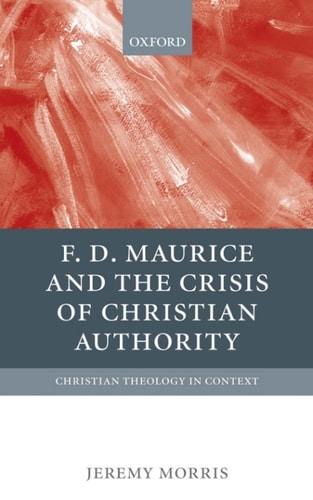
F. D. Maurice and the Crisis of Christian Authority: Christian Theology in Context
0
0
As an Amazon Associate and affiliate partner, Menrva Books earns from qualifying purchases. Learn more
Author Description
This book offers a reassessment of the theology of F. D. Maurice (1805-72), one of the most significant theologians of the modern Church of England. It seeks to place Maurice's theology in the context of nineteenth-century conflicts over the social role of the Church, and over the truth of the Christian revelation. Maurice is known today mostly for his seminal role in the formation of Christian Socialism, and for his dismissal from his chair at King's College, London, over his denial of the doctrine of eternal punishment. Drawing on the whole range of Maurice's extensive published work, this book argues that his theology, and his social and educational activity, were held together above all by his commitment to a renewal of Anglican ecclesiology. At a time when, following the social upheavals of the French Revolution and the Industrial Revolution, many of his contemporaries feared that the authority of the Christian Church - and particularly of the Church of England - was under threat, Maurice sought to reinvigorate his Church's sense of mission by emphasizing its national responsibility, and its theological inclusiveness. In the process, he pioneered a new appreciation of the diversity of Christian traditions that was to be of great importance for the Church of England's ecumenical commitment. He also sought to limit the damage of internal Church division, by promoting a view of the Church's comprehensiveness that acknowledged the complementary truth of convictions fiercely held by competing parties.
Menrva's Summary
THE THESIS
This book investigates how F. D. Maurice navigated the crisis of Christian authority in the nineteenth century by re-evaluating his theological contributions to Anglican ecclesiology. Jeremy Morris, a scholar of ecclesiastical history, utilizes Maurice's extensive published corpus to challenge the narrow perception of him as merely a Christian Socialist. The author argues that Maurice's primary objective was to reconcile the Church of England's social mission with its theological identity during a period of intense industrial and political upheaval. By examining Maurice's dismissal from King's College and his broader intellectual output, Morris constructs a framework that positions Maurice as a pioneer of ecumenical inclusivity and institutional comprehensiveness.
THE SCOPE MAP
What You Will Find
- Analysis of nineteenth-century Anglican ecclesiology and social reform.
- Examination of Maurice's response to the French and Industrial Revolutions.
- Detailed study of Maurice's views on national responsibility and theological diversity.
- Contextualization of the controversy surrounding the doctrine of eternal punishment.
Scope Limits
- The text does not provide a comprehensive biography of Maurice's personal life outside of his theological and professional career.
- It does not offer an exhaustive critique of all contemporary theological movements outside the Church of England.
THE AUTHORITY PERSPECTIVE
Scholars and theologians recognize this work as a significant contribution to the study of Victorian religious thought and the development of modern Anglicanism. Readers frequently note the academic density of the prose, which is intended for those with a background in historical theology or church history.
Page Count:
256
Publication Date:
2008-01-01
Publisher:
Oxford University Press
ISBN-10:
0191566764
ISBN-13:
9780191566769
Biography
Religion
Nineteenth century
Christian Theology
Church History
Anglicanism