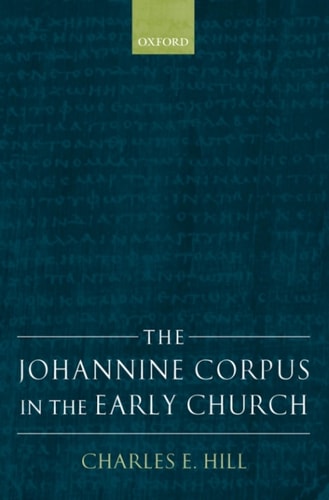
The Johannine Corpus in the Early Church
0
0
As an Amazon Associate and affiliate partner, Menrva Books earns from qualifying purchases. Learn more
Author Description
How were the Johannine books of the New Testament received by second-century Christians and accorded scriptural status? Charles E. Hill offers a fresh and detailed examination of this question. He dismantles the long-held theory that the Fourth Gospel was generally avoided or resisted by orthodox Christians, while being treasured by various dissenting groups, throughout most of the second century. Integrating a wide range of literary and non-literary sources, this book demonstrates the failure of several old stereotypes about the Johannine literature. It also collects the full evidence for the second-century Church's conception of these writings as a group: the Johannine books cannot be isolated from each other but must be recognized as a corpus.
Menrva's Summary
THE THESIS
How were the Johannine books of the New Testament received by second-century Christians and accorded scriptural status? Charles E. Hill, a scholar of early Christian history, investigates the historical reception of the Fourth Gospel and the Johannine epistles. By analyzing a broad spectrum of literary and non-literary evidence, he challenges the prevailing academic consensus that these texts were initially rejected by orthodox communities and favored primarily by dissenting groups. The author argues that these writings were viewed as a unified corpus by the early Church rather than isolated documents.
THE SCOPE MAP
What You Will Find
- Analysis of second-century Christian reception of the Johannine literature
- Examination of the relationship between the Fourth Gospel and the Johannine epistles as a collective corpus
- Integration of diverse primary source materials including patristic writings and early Christian fragments
Scope Limits
- The study focuses primarily on the second century and does not provide an exhaustive analysis of later patristic interpretations
- The work does not address modern theological debates regarding the authorship of the Johannine texts
THE AUTHORITY PERSPECTIVE
Scholars and students of early church history frequently cite this work for its rigorous re-evaluation of long-standing academic stereotypes regarding the Johannine corpus. The text is noted for its high level of academic density and its meticulous engagement with primary source evidence.
Page Count:
552
Publication Date:
2004-01-01
Publisher:
OUP Oxford
ISBN-10:
0191532649
ISBN-13:
9780191532641
Religion
Church History
Christian Theology
New Testament
Early Christianity
Community Tags
Other Editions(3)
Similar Books