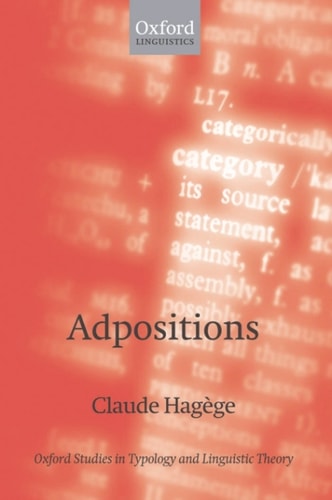
Adpositions
0
0
As an Amazon Associate and affiliate partner, Menrva Books earns from qualifying purchases. Learn more
Author Description
This pioneering study is based on an analysis of over 200 languages, including African, Amerindian, Australian, Austronesian, Indo-European and Eurasian (Altaic, Caucasian, Chukotko-Kamchatkan, Dravidian, Uralic), Papuan, and Sino-Tibetan. Adpositions are an almost universal part of speech. English has prepositions; some languages, such as Japanese, have postpositions; others have both; and yet others kinds that are not quite either. As grammatical tools they mark the relationship between two parts of a sentence: characteristically one element governs a noun or noun-like word or phrase while the other functions as a predicate. From the syntactic point of view, the complement of an adposition depends on a head: in this last sentence, for example, a head is the complement of on while on a head depends on depends and on is the marker of this dependency. Adpositions lie at the core of the grammar of most languages, their usefulness making them recurrent in everyday speech and writing. Claude Hagège examines their morphological features, syntactic functions, and semantic and cognitive properties. He does so for the subsets both of adpositions that express the relations of agent, patient, and beneficiary, and of those which mark space, time, accompaniment, or instrument. Adpositions often govern case and are sometimes gradually grammaticalized into case. The author considers the whole set of function markers, including case, that appear as adpositions and, in doing so, throws light on processes of morphological and syntactic change in different languages and language families. His book will be welcomed by typologists and by syntacticians and morphologists of all theoretical stripes.
Menrva's Summary
THE THESIS
This study investigates the universal grammatical role of adpositions by analyzing their morphological, syntactic, and semantic properties across a vast array of global languages. Claude Hagège, a noted linguist, utilizes a comparative typological framework to examine how adpositions function as markers of dependency between sentence elements. By drawing on data from over 200 languages, the author argues that adpositions are central to understanding grammatical change and the evolution of case systems.
THE SCOPE MAP
What You Will Find
- Comparative analysis of over 200 languages including African, Amerindian, Australian, and Indo-European families
- Examination of morphological features and syntactic functions of adpositions
- Analysis of semantic properties related to agent, patient, beneficiary, space, time, and instrument
- Discussion of grammaticalization processes where adpositions evolve into case markers
Scope Limits
- The text focuses primarily on typological and syntactic structures rather than prescriptive usage or pedagogical instruction
- It does not provide an exhaustive dictionary of adpositions for any single language
THE AUTHORITY PERSPECTIVE
Experts recognize this work as a significant contribution to linguistic typology, particularly for its breadth of cross-linguistic data. Readers frequently note the academic density of the prose, making it most suitable for professional linguists, syntacticians, and advanced students of language structure.
Page Count:
352
Publication Date:
2010-01-01
Publisher:
Oxford University Press
ISBN-10:
0191573469
ISBN-13:
9780191573460
Morphology
English
Typology
Syntax
English & College Success
Grammar
Reference
Linguistics
Community Tags
Similar Books