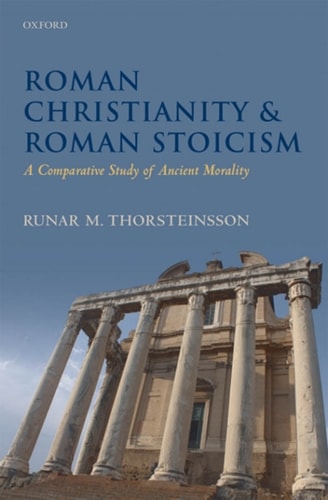
Roman Christianity and Roman Stoicism: A Comparative Study of Ancient Morality
0
0
As an Amazon Associate and affiliate partner, Menrva Books earns from qualifying purchases. Learn more
Author Description
Christianity is commonly held to have introduced an entirely new and better morality into the ancient world, a new morality that was decidedly universal, in contrast to the ethics of the philosophical schools which were only concerned with the intellectual few. Runar M. Thorsteinsson presents a challenge to this view by comparing Christian morality in first-century Rome with contemporary Stoic ethics in the city. Thorsteinsson introduces and discusses the moral teaching of Roman Stoicism; of Seneca, Musonius Rufus, and Epictetus. He then presents the moral teaching of Roman Christianity as it is represented in Paul's Letter to the Romans, the First Letter of Peter, and the First Letter of Clement. Having established the bases for his comparison, he examines the similarities and differences between Roman Stoicism and Roman Christianity in terms of morality. Five broad themes are used for the comparison, questions of Christian and Stoic views about: a particular morality or way of life as proper worship of the deity; certain individuals (like Jesus and Socrates) as paradigms for the proper way of life; the importance of mutual love and care; non-retaliation and 'love of enemies'; and the social dimension of ethics. This approach reveals a fundamental similarity between the moral teachings of Roman Christianity and Roman Stoicism. The most basic difference is found in the ethical scope of the two: While the latter teaches unqualified universal humanity, the former seems to condition the ethical scope in terms of religious adherence.
Menrva's Summary
THE THESIS
This study investigates the extent to which early Roman Christianity and contemporary Stoic ethics shared a common moral framework in the first century. Runar M. Thorsteinsson, a scholar of early Christian history, utilizes a comparative methodology to analyze primary texts from both traditions. By juxtaposing the writings of Stoic philosophers like Seneca and Epictetus against early Christian documents such as the Letter to the Romans, the author challenges the traditional assumption that Christian morality represented a radical, unprecedented departure from existing philosophical schools.
THE SCOPE MAP
What You Will Find
- Comparative analysis of moral teachings in first-century Rome.
- Examination of five thematic pillars: worship, moral paradigms, mutual care, non-retaliation, and social ethics.
- Analysis of primary sources including the works of Seneca, Musonius Rufus, Epictetus, Paul’s Letter to the Romans, and the First Letter of Clement.
Scope Limits
- The study focuses specifically on the Roman context of the first century and does not extend to later developments in Christian or Stoic thought.
- The analysis is restricted to the moral and ethical dimensions of these traditions rather than their metaphysical or theological systems.
THE AUTHORITY PERSPECTIVE
Scholars and students of classical history and theology frequently cite this work as a rigorous, balanced examination of the intersection between early Christian ethics and Hellenistic philosophy. Readers often note the academic density of the prose, which is intended for those with a background in ancient history or religious studies.
Page Count:
240
Publication Date:
2010-01-01
Publisher:
Oxford University Press, USA
ISBN-10:
0191576794
ISBN-13:
9780191576799
Philosophy
History
Religion
Stoics
Ethics
Ancient - Rome
Christianity
Ethics Ancient
stoicism
Community Tags
Similar Books