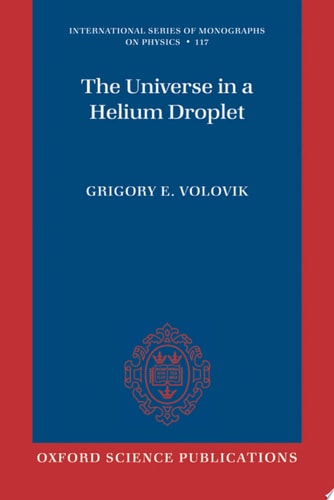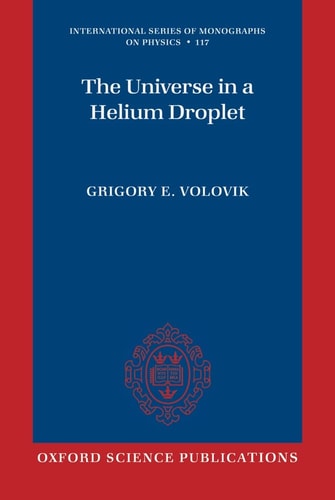
The Universe in a Helium Droplet
0
0
As an Amazon Associate and affiliate partner, Menrva Books earns from qualifying purchases. Learn more
Author Description
There are fundamental relations between three vast areas of physics: particle physics, cosmology and condensed matter physics. The fundamental links between the first two areas, in other words, between micro-and macro-worlds, have been well established. There is a unified system of laws governing the scales from subatomic particles to the Cosmos and this principle is widely exploited in the description of the physics of the early Universe. The main goal of this book is to establish and define the connection of these two fields with condensed matter physics.According to the modern view, elementary particles (electrons, neutrinos, quarks, etc.) are excitations of a more fundamental medium called the quantum vacuum. This is the new 'aether' of the 21st Century. Electromagnetism, gravity, and the fields transferring weak and strong interactions all represent different types of the collective motion of the quantum vacuum. Among the existing condensed matter systems, a quantum liquid called superfluid 3He-A most closely represents the quantum vacuum. Its quasiparticles are very similar to the elementary particles, while the collective modes are analogues of photons and gravitons. The fundamental laws of physics, such as the laws of relativity (Lorentz invariance) and gauge invariance, arise when the temperature of the quantum liquid decreases.Now New in Paperback
Menrva's Summary
THE THESIS
This book investigates the fundamental connections between particle physics, cosmology, and condensed matter physics by proposing that the quantum vacuum acts as a physical medium analogous to superfluid 3He-A. Grigory E. Volovik, a prominent physicist, utilizes his expertise in condensed matter to argue that elementary particles and fundamental forces are collective excitations of this quantum vacuum. By drawing parallels between the behavior of superfluid helium and the early universe, the author constructs a framework that suggests physical laws like Lorentz invariance emerge as collective properties of a quantum liquid at low temperatures.
THE SCOPE MAP
What You Will Find
- Comparative analysis of particle physics, cosmology, and condensed matter systems.
- Theoretical framework defining the quantum vacuum as a physical medium.
- Analogies between quasiparticles in superfluid 3He-A and elementary particles.
- Discussion on the emergence of gauge invariance and relativity from collective motion.
THE AUTHORITY PERSPECTIVE
Experts recognize this work as a significant contribution to the study of vacuum physics and the unification of disparate physical scales. Readers frequently note the high level of technical density, making it a specialized resource for researchers and advanced students in theoretical physics.
Page Count:
536
Publication Date:
2009-05-15
Publisher:
Oxford University Press
ISBN-10:
0199564841
ISBN-13:
9780199564842
Science
Quantum Theory
Physics
Liquid Helium
Cosmology
Condensed Matter Physics