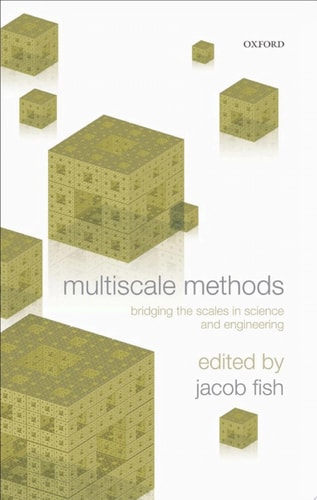
Multiscale Methods: Bridging the Scales in Science and Engineering
0
0
As an Amazon Associate and affiliate partner, Menrva Books earns from qualifying purchases. Learn more
Author Description
Small scale features and processes occurring at nanometer and femtosecond scales have a profound impact on what happens at a larger scale and over an extensive period of time. The primary objective of this volume is to reflect the state-of-the-art in multiscale mathematics, modeling, and simulations and to address the following barriers: What is the information that needs to be transferred from one model or scale to another and what physical principles must be satisfied during the transfer of information? What are the optimal ways to achieve such transfer of information? How can variability of physical parameters at multiple scales be quantified and how can it be accounted for to ensure design robustness? The multiscale approaches in space and time presented in this volume are grouped into two main categories: information-passing and concurrent. In the concurrent approaches various scales are simultaneously resolved, whereas in the information-passing methods the fine scale is modeled and its gross response is infused into the continuum scale. The issue of reliability of multiscale modeling and simulation tools which focus on a hierarchy of multiscale models and an a posteriori model of error estimation including uncertainty quantification, is discussed in several chapters. Component software that can be effectively combined to address a wide range of multiscale simulations is also described. Applications range from advanced materials to nanoelectromechanical systems (NEMS), biological systems, and nanoporous catalysts where physical phenomena operates across 12 orders of magnitude in time scales and 10 orders of magnitude in spatial scales. This volume is a valuable reference book for scientists, engineers and graduate students practicing in traditional engineering and science disciplines as well as in emerging fields of nanotechnology, biotechnology, microelectronics and energy.
Menrva's Summary
THE THESIS
This volume investigates the mathematical and physical methodologies required to bridge disparate spatial and temporal scales in scientific and engineering simulations. Author Jacob Fish, a specialist in computational mechanics, synthesizes current research to address how information transfers between scales, the physical principles governing these transitions, and the quantification of parameter variability to ensure design robustness. The text provides a rigorous framework for evaluating the reliability of multiscale models through error estimation and uncertainty quantification.
THE SCOPE MAP
What You Will Find
- Information-passing and concurrent multiscale modeling methodologies
- A posteriori error estimation and uncertainty quantification techniques
- Integration of component software for multiscale simulations
- Applications in NEMS, biological systems, and nanoporous catalysts
Scope Limits
- Does not provide a comprehensive history of computational physics
- Excludes basic introductory material for undergraduate-level physics
THE AUTHORITY PERSPECTIVE
Experts identify this work as a technical resource for researchers and graduate students engaged in complex multi-physics simulations. Readers frequently note the high level of mathematical density and the specialized focus on bridging orders of magnitude in spatial and temporal scales.
Page Count:
1090
Publication Date:
2009-01-01
Publisher:
OUP Oxford
ISBN-10:
0191579734
ISBN-13:
9780191579738
Science
Computational Physics
Mathematics
Nanotechnology
Engineering
Mathematics Statistics
Mathematics - General
Community Tags
Similar Books