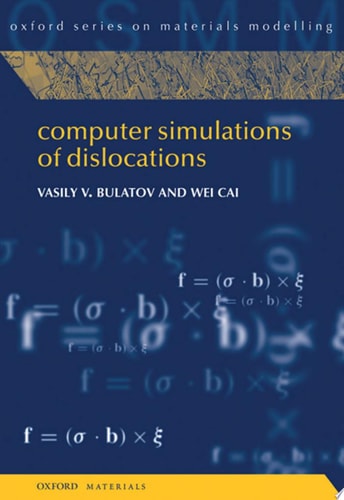
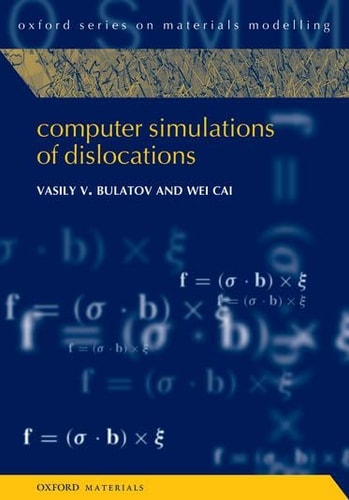
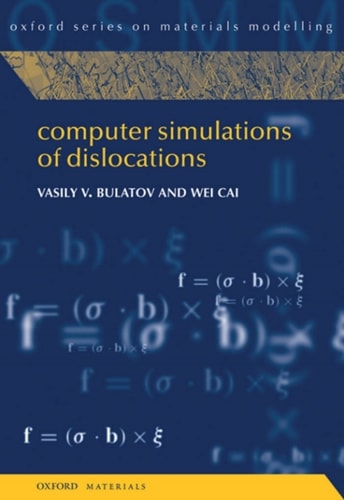
Computer Simulations of Dislocations
0
0
As an Amazon Associate and affiliate partner, Menrva Books earns from qualifying purchases. Learn more
Author Description
This book presents a broad collection of models and computational methods - from atomistic to continuum - applied to crystal dislocations. Its purpose is to help students and researchers in computational materials sciences to acquire practical knowledge of relevant simulation methods. Because their behavior spans multiple length and time scales, crystal dislocations present a common ground for an in-depth discussion of a variety of computational approaches, including their relative strengths, weaknesses and inter-connections. The details of the covered methods are presented in the form of "numerical recipes" and illustrated by case studies. A suite of simulation codes and data files is made available on the book's website to help the reader "to learn-by-doing" through solving the exercise problems offered in the book.
Menrva's Summary
THE THESIS
This book investigates the application of diverse computational modeling techniques to understand the behavior of crystal dislocations across varying length and time scales. The authors, Vasily Bulatov and Wei Cai, leverage their expertise in materials science to provide a comprehensive framework that bridges atomistic and continuum modeling. By presenting these methods as practical numerical recipes, the text aims to equip researchers and students with the necessary tools to simulate complex dislocation dynamics effectively.
THE SCOPE MAP
What You Will Find
- A comprehensive overview of computational methods ranging from atomistic to continuum scales.
- Practical numerical recipes for implementing dislocation simulations in research environments.
- Illustrative case studies that demonstrate the application of models to real-world crystal structures.
- A suite of simulation codes and data files designed to facilitate hands-on learning through exercise problems.
THE AUTHORITY PERSPECTIVE
Experts and researchers in the field of materials modeling frequently cite this work as a foundational resource for understanding the multi-scale nature of dislocation simulations. Readers often note the technical clarity of the numerical recipes, which makes complex computational concepts accessible for practical application in academic and industrial research.
Page Count:
304
Publication Date:
2006-12-28
Publisher:
Oxford University Press
ISBN-10:
0198526148
ISBN-13:
9780198526148
Science
Engineering
Dislocations In Crystals
Physics
Computer Science
Computational Physics
Community Tags
Other Editions(3)
Similar Books