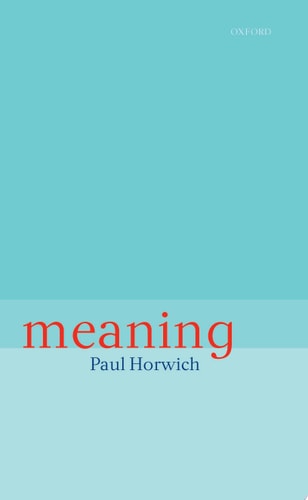
Meaning
0
0
As an Amazon Associate and affiliate partner, Menrva Books earns from qualifying purchases. Learn more
Author Description
What is meaning? Paul Horwich presents an original philosophical theory, demonstrates its richness, and defends it against all comers. At the core of his theory is the idea, made famous by Wittgenstein, that the meaning of a word derives from its use; Horwich articulates this idea in a new way that will restore it to the prominence that it deserves. He surveys the diversity of valuable insights into meaning that have been gained in the twentieth century, and seeks to accommodate them within his theory. His aim is not to correct a common-sense view of meaning, but to vindicate it: he seeks to take the mystery out of meaning. Horwich's 1990 book Truth established itself both as the definitive exposition and defence of a notable philosophical theory, `minimalism', and as a stimulating, straightforward introduction to philosophical debate about truth. Meaning now gives the broader context in which the theory of truth operates, and is published simultaneously with a revised edition of Truth, in which Horwich refines and develops his treatment of the subject in the light of subsequent discussions, while preserving the distinctive format which made the book so successful. The two books together present a compelling view of the relations between language, thought, and reality. They will be essential reading for all philosophers of language.
Menrva's Summary
THE THESIS
Paul Horwich investigates the fundamental nature of linguistic meaning by proposing a deflationary, use-based theory that seeks to demystify the concept. Drawing on his background as a prominent philosopher of language, Horwich synthesizes twentieth-century insights to argue that meaning is derived from the functional use of words rather than abstract entities. He aims to vindicate common-sense intuitions about language by providing a rigorous, minimalist framework that integrates his previous work on the nature of truth.
THE SCOPE MAP
What You Will Find
- A defense of the use-theory of meaning inspired by Wittgensteinian principles.
- An integration of diverse twentieth-century semantic insights into a unified minimalist framework.
- A systematic analysis of the relationship between language, thought, and reality.
Scope Limits
- The text does not provide a historical survey of all semantic theories but focuses specifically on the author's own minimalist proposal.
- It does not address non-analytic or continental philosophical perspectives on language.
THE AUTHORITY PERSPECTIVE
Experts recognize this work as a foundational text for understanding the minimalist approach to semantics and its intersection with the philosophy of truth. Readers frequently note the technical density of the prose, which is intended for those already familiar with contemporary debates in the philosophy of language.
Page Count:
254
Publication Date:
1998-01-01
Publisher:
Clarendon Press
ISBN-10:
0191574007
ISBN-13:
9780191574009
Philosophy
Semantics
Epistemology
Philosophy of
Phenomenology
Community Tags
Other Editions(3)
Similar Books