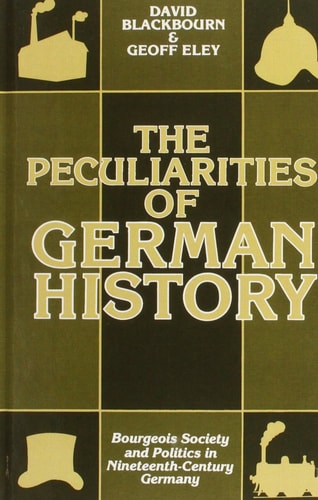
The Peculiarities of German History: Bourgeois Society and Politics in Nineteenth-Century Germany
0
0
As an Amazon Associate and affiliate partner, Menrva Books earns from qualifying purchases. Learn more
Author Description
A well-written, stimulating...piece of scholarship. --German Studies Review. In a major re-evaluation of the cultural, political, and sociological assumptions about the "peculiar" course of modern German history, the authors challenge the widely held belief that Germany did not have a Western-style bourgeois revolution. Contending that it did indeed experience one, but that this had little to do with the mythical rising of the middle class, the authors provide a new context for viewing the tensions and instability of 19th-and early 20th-century Germany.
Menrva's Summary
THE THESIS
This work investigates the validity of the Sonderweg thesis, which posits that Germany followed a unique and deviant path toward modernity compared to other Western nations. Authors David Blackbourn and Geoff Eley, both established historians of modern Germany, utilize a revisionist framework to challenge the traditional historiographical assumption that Germany lacked a bourgeois revolution. By decoupling the concept of a bourgeois revolution from the specific political model of the French experience, they argue that Germany underwent a thorough modernization led by the middle class through cultural and social spheres rather than purely political upheaval.
THE SCOPE MAP
What You Will Find
- A critical analysis of the German middle class in the 19th and early 20th centuries.
- A re-evaluation of the relationship between the German state and civil society.
- A comparative historical methodology contrasting Germany with Britain and France.
Scope Limits
- The text does not provide a comprehensive military or diplomatic history of the period.
- It focuses primarily on the structural and sociological aspects of the German state rather than individual biographies.
THE AUTHORITY PERSPECTIVE
Historians and scholars of German studies frequently cite this text as a foundational work that shifted the paradigm of modern German historiography. Readers often note the academic density of the prose, which assumes a baseline familiarity with 19th-century European political theory and historical debate.
Page Count:
300
Publication Date:
1984-01-01
Publisher:
Oxford University Press
ISBN-10:
0191585998
ISBN-13:
9780191585999
History
European History
Sociology
19th Century
German history