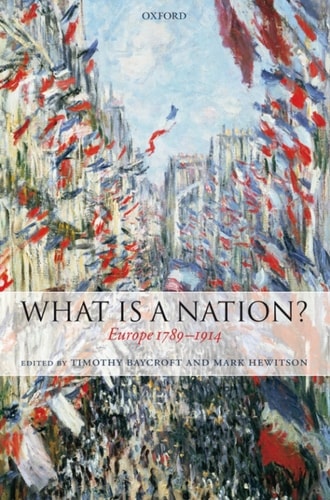
What Is a Nation?: Europe 1789-1914
0
0
As an Amazon Associate and affiliate partner, Menrva Books earns from qualifying purchases. Learn more
Author Description
This volume analyses and compares different forms of nationalism across a range of European countries and regions during the long nineteenth century. It aims to put detailed studies of nationalist politics and thought, which have proliferated over the last ten years or so, into a wider European context. By means of such contextualization, together with new and systematic comparisons, What is a Nation? Europe 1789-1914 reassesses the arguments put forward in the principal works on nationalism as a whole, many of which pre-date the proliferation of case studies in the 1990s and which, as a consequence, make only inadequate reference to the national histories of European states. The study reconsiders whether the distinction between civic and ethnic identities and politics in Europe has been overstated and whether it needs to be replaced altogether by a new set of concepts or types. What is a Nation? explores the relationship between this and other typologies, relating them to complex processes of industrialization, increasing state intervention, secularization, democratization and urbanization. Debates about citizenship, political economy, liberal institutions, socialism, empire, changes in the states system, Darwinism, high and popular culture, Romanticism and Christianity all affected - and were affected by - discussion of nationhood and nationalist politics. The volume investigates the significance of such controversies and institutional changes for the history of modern nationalism, as it was defined in diverse European countries and regions during the long nineteenth century. By placing particular nineteenth-century nationalist movements and nation-building in a broader comparative context, prominent historians of particular European states give an original and authoritative reassessment, designed to appeal to students and academic readers alike, of one of the most contentious topics of the modern period.
Menrva's Summary
THE THESIS
This volume investigates the evolution and comparative nature of nationalism across European states during the long nineteenth century, questioning whether traditional distinctions between civic and ethnic identities remain analytically valid. The authors, Mark Hewitson and Timothy Baycroft, curate a collection of essays from prominent historians to synthesize recent case studies into a broader, systematic framework. By examining the intersection of nationalism with industrialization, democratization, and secularization, the text challenges established theories that often lack empirical depth regarding specific national histories.
THE SCOPE MAP
What You Will Find
- Comparative analysis of nationalist politics and thought across diverse European regions.
- Examination of the relationship between nation-building and institutional changes like urbanization and state intervention.
- Integration of cultural and intellectual history, including the influence of Romanticism, Darwinism, and Christianity.
Scope Limits
- The analysis is strictly confined to the European context between 1789 and 1914.
- The text does not provide a comprehensive global history of nationalism outside of the European sphere.
THE AUTHORITY PERSPECTIVE
Experts recognize this volume as a significant contribution to the historiography of nationalism, particularly for its effort to bridge the gap between localized case studies and broader theoretical models. Readers frequently note the academic density of the prose, making it a valuable resource for students and scholars engaged in advanced historical research.
Page Count:
400
Publication Date:
2006-01-01
Publisher:
OUP Oxford
ISBN-10:
0191516287
ISBN-13:
9780191516283
History
Nationalism
19th Century
Sociology
European History
Community Tags
Similar Books