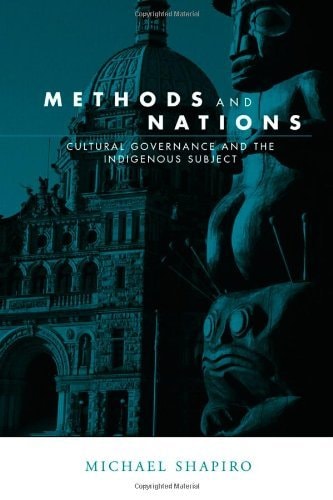
Methods and Nations: Cultural Governance and the Indigenous Subject
0
0
As an Amazon Associate and affiliate partner, Menrva Books earns from qualifying purchases. Learn more
Author Description
Methods and Nations critiques one of the primary deployments of twentieth-century social science: comparative politics whose major focus has been "nation-building" in the "Third World," often attempting to universalize and render self-evident its own practices. International relations theorists, unable to resist the "cognitive imperialism" of a state-centric social science, have allowed themselves to become colonized. Michael Shapiro seeks to bring recognition to forms of political expression-alternative modes of intelligibility for things, people, and spaces-that have existed on the margins of the nationhood practices of states and the complicit nation-sustaining conceits of social science.
Menrva's Summary
THE THESIS
This work investigates the cognitive imperialism inherent in comparative politics and international relations, specifically challenging how state-centric social science constructs and marginalizes the Indigenous subject. Michael J. Shapiro, a prominent political theorist, utilizes a critical framework to dismantle the universalizing tendencies of nation-building narratives. By analyzing the historical and theoretical foundations of social science, he argues that these disciplines have functioned as tools of colonization rather than objective inquiry. The text proposes a shift toward recognizing alternative modes of political expression that exist outside the traditional boundaries of the nation-state.
THE SCOPE MAP
What You Will Find
- A critique of comparative politics and its focus on Third World nation-building.
- An examination of cognitive imperialism within international relations theory.
- Theoretical analysis of state-centric social science methodologies.
- Exploration of alternative political intelligibility for marginalized spaces and peoples.
THE AUTHORITY PERSPECTIVE
Scholars in political theory and post-colonial studies frequently cite this text for its rigorous deconstruction of traditional academic frameworks. Readers often note the dense, theoretical nature of the prose, which is intended for an audience familiar with critical social science discourse.
Page Count:
282
Publication Date:
2004-01-01
Publisher:
Routledge
ISBN-10:
0203503775
ISBN-13:
9780203503775
Politics
International relations
Kindle eBooks
Self Service
Sociology
Kindle Store
Categories
Custom Stores
World politics