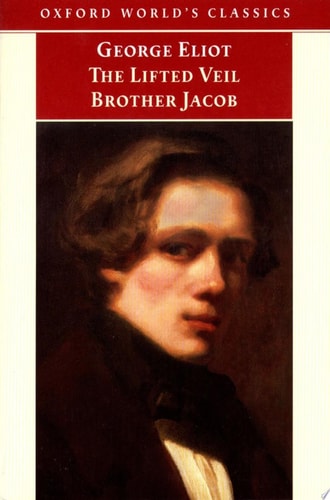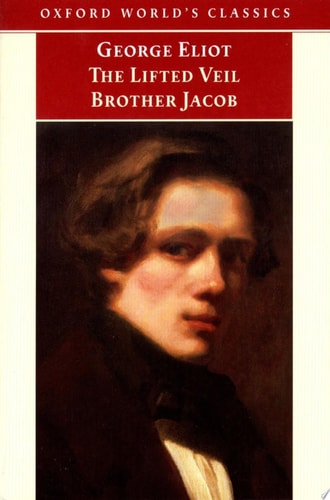
The Lifted Veil and Brother Jacob
0
0
As an Amazon Associate and affiliate partner, Menrva Books earns from qualifying purchases. Learn more
Author Description
'She had believed that my wild poet's passion for her would make me her slave; and that, being her slave, I should execute her will in all things.' The Lifted Veil was first published in Blackwood's Magazine in 1859. A dark fantasy woven from contemporary scientific interest in the physiology of the brain, mesmerism, phrenology and experiments in revification it is Eliot's anatomy of her own moral philsophy - the ideal of imaginative sympathy or the ability to see into others' minds and emotions. Narrated by an egoccentric, morbid young clairvoyant man whose fascination for Bertha Grant lies partly in her obliquity, the story also explores fiction's ability to offer insight into the self, as well as being a remarkable portrait of a misdeveloped artist whose visionary powers merely blight his life. The Lifted Veil is now one of the most widely read and critically discussed of Eliot's works. Published as a companion piece to The Lifted Veil, Brother Jacob is by contrast Eliot's literary homage to Thackeray, a satirical modern fable that draws telling parallels between eating and reading. Yet both stories reveal Eliot's deep engagement with the question of whether there are 'necessary truths' independent of our perception of them and the boundaries of art and the self. Helen Small's introduction casts new light on works which fully deserve to be read alongside Eliot's novels.
Menrva's Summary
THE PULSE
A morbid, clairvoyant man finds his life blighted by the unwanted ability to perceive the inner thoughts and emotions of those around him. The protagonist, Latimer, navigates a world where his visionary powers strip away the social masks of his peers, leading to profound isolation and a destructive obsession with the enigmatic Bertha Grant. His narrative, presented in a first-person framework, serves as a clinical examination of the psychological toll of forced empathy. Opposed by the rigid social expectations of his time and his own egocentric nature, he struggles to reconcile his internal perceptions with the external reality of his relationships.
INSIDE THE PAGES
- First-person confessional narrative style
- Exploration of Victorian scientific interests including mesmerism and phrenology
- Examination of the moral philosophy of imaginative sympathy
- Satirical elements contrasting with gothic psychological tension
- Focus on the limitations of human perception and self-knowledge
- Character study of a misdeveloped artist
- Thematic parallels between consumption and intellectual engagement
- Philosophical inquiry into the existence of objective truths
THE COLLECTIVE ECHO
Discussion often centers on the stark contrast between the haunting, introspective nature of the title story and the lighter, satirical tone of the companion piece. Readers frequently highlight the effectiveness of Eliot's exploration of clairvoyance as a metaphor for the burden of excessive self-consciousness. Critics often examine how these works function as an anatomy of the author's own moral philosophy regarding the limits of human connection. The text is widely regarded for its ability to challenge the reader's understanding of the boundaries between art, the self, and the perception of reality. Many find the psychological depth of the protagonist to be a significant departure from the broader social canvases found in Eliot's longer novels.
Page Count:
160
Publication Date:
1999-01-01
Publisher:
Oup Oxford
ISBN-10:
0191586080
ISBN-13:
9780191586088
Satire
Psychological
Classic Literature
Short Stories
Victorian
Gothic