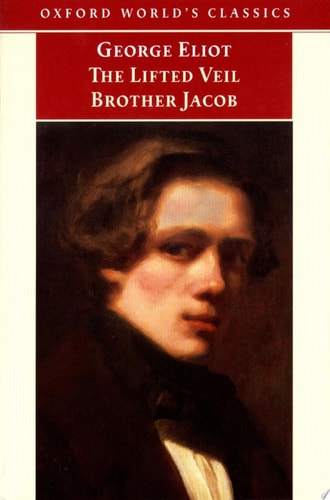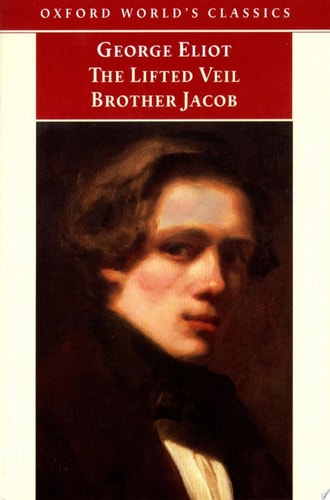
The Lifted Veil and Brother Jacob
0
0
As an Amazon Associate and affiliate partner, Menrva Books earns from qualifying purchases. Learn more
Author Description
First published in Blackwood's Magazine in 1859, "The Lifted Veil" is now one of George Eliot's most widely read and critically discussed short stories. A dark fantasy drawing on contemporary scientific interest in the physiology of the brain, mesmerism, phrenology, and experiments in revification, it is Eliot's anatomy of her own moral philosophy. Narrated by an egocentric, morbid young clairvoyant man, the story also explores fiction's ability to offer insight into the self, as well as being a remarkable portrait of an artist whose visionary powers merely blight his life.Published as a companion piece to "The Lifted Veil," "Brother Jacob" is by contrast Eliot's literary homage to Thackeray, a satirical modern fable that draws telling parallels between eating and reading. With an illuminating introduction by Helen Small, this Oxford World's Classics edition makes newly available two fascinating short stories which fully deserve to be read alongside Eliot's novels.About the Series: For over 100 years Oxford World's Classics has made available the broadest spectrum of literature from around the globe. Each affordable volume reflects Oxford's commitment to scholarship, providing the most accurate text plus a wealth of other valuable features, including expert introductions by leading authorities, voluminous notes to clarify the text, up-to-date bibliographies for further study, and much more.
Menrva's Summary
THE PULSE
A morbid clairvoyant finds his life blighted by the burden of his own unwanted visionary powers. Latimer, an egocentric and isolated protagonist, navigates a world where his ability to perceive the thoughts of others and foresee the future isolates him from human connection. He struggles against the deterministic nature of his visions, which reveal the hollow motivations of those around him, including his cold-hearted wife. The narrative framework is a first-person confession, providing a claustrophobic look at a man trapped by his own psychological and physiological limitations. The story examines the intersection of Victorian scientific curiosity and the darker aspects of human consciousness.
INSIDE THE PAGES
- First-person confessional narrative style
- Exploration of Victorian scientific interests like mesmerism and phrenology
- Themes of determinism and the isolation of the individual
- Satirical elements present in the companion fable
- Psychological character study of an unreliable narrator
- Commentary on the nature of visionary power and artistic perception
- Philosophical inquiry into moral responsibility
- Contrast between dark fantasy and modern fable genres
THE COLLECTIVE ECHO
Readers frequently highlight the stark contrast between the haunting, psychological intensity of the title story and the lighter, satirical tone of the companion piece. Discussion often centers on how Eliot utilizes the supernatural to critique the social and moral conventions of her time. Critics often point to the protagonist's alienation as a precursor to later modernist explorations of the fractured self. The inclusion of scholarly introductions and notes in this edition is frequently praised for providing necessary context regarding the scientific debates of the nineteenth century. Many readers find the pairing of these two distinct works to be an effective way to observe the breadth of Eliot's literary range.
Page Count:
104
Publication Date:
2009-04-15
Publisher:
Oxford University Press
ISBN-10:
0199555052
ISBN-13:
9780199555055
Fantasy
Classic Literature
Short Stories
Victorian
Gothic
Fiction psychological