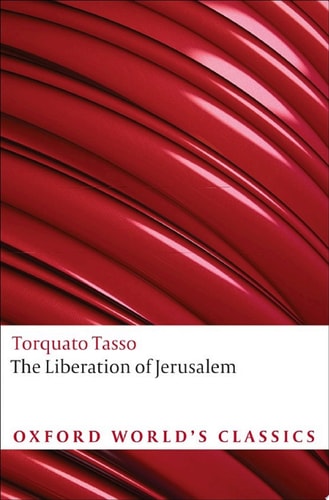
The Liberation of Jerusalem
0
0
As an Amazon Associate and affiliate partner, Menrva Books earns from qualifying purchases. Learn more
Author Description
'The bitter tragedy of human life-- horrors of death, attack, retreat, advance, and the great game of Destiny and Chance. ' In The Liberation of Jerusalem (Gerusalemme liberata, 1581), Torquato Tasso set out to write an epic to rival the Iliad and the Aeneid. Unlike his predecessors, he took his subject not from myth but from history: the Christian capture of Jerusalem during the First Crusade. The siege of the city is played out alongside a magical romance of love and sacrifice, in which the Christian knight Rinaldo succumbs to the charms of the pagan sorceress Armida, and the warrior maiden Clorinda inspires a fatal passion in the Christian Tancred. Tasso's masterpiece left its mark on writers from Spenser and Milton to Goethe and Byron, and inspired countless painters and composers. This is the first English translation in modern times that faithfully reflects both the sense and the verse form of the original. Max Wickert's fine rendering is introduced by Mark Davie, who places Tasso's poem in the context of his life and times and points to the qualities that have ensured its lasting impact on Western culture. ABOUT THE SERIES: For over 100 years Oxford World's Classics has made available the widest range of literature from around the globe. Each affordable volume reflects Oxford's commitment to scholarship, providing the most accurate text plus a wealth of other valuable features, including expert introductions by leading authorities, helpful notes to clarify the text, up-to-date bibliographies for further study, and much more.
Menrva's Summary
THE PULSE
The central conflict arises from the Christian forces' attempt to capture Jerusalem during the First Crusade, complicated by the intervention of supernatural powers and personal desires.
Christian knights, led by Godfrey of Bouillon, seek to secure the Holy City against the Saracen defenders. Their objective is hindered by both the physical fortifications of the city and the magical machinations of pagan sorcerers who manipulate the soldiers' emotions. The narrative, structured as an epic poem, balances the rigid demands of military duty against the volatile nature of human passion. The poem utilizes a complex interplay of historical events and mythological elements to explore the tension between religious devotion and individual longing.
INSIDE THE PAGES
- Use of ottava rima verse form to maintain rhythmic consistency.
- Integration of historical events from the First Crusade with fictionalized romantic subplots.
- Inclusion of supernatural elements, including sorcery and divine intervention.
- Focus on the psychological conflict between duty and personal desire.
- Portrayal of archetypal characters such as the warrior maiden and the enchanted knight.
- Exploration of themes regarding sacrifice, honor, and the nature of love.
- Detailed descriptions of siege warfare and tactical military maneuvers.
- Influence of classical epic structures reminiscent of the Iliad and the Aeneid.
THE COLLECTIVE ECHO
Readers and critics frequently analyze the work for its technical mastery of the epic form and its significant influence on later European literature. Discussion often centers on the balance Tasso strikes between the historical reality of the Crusades and the fantastical elements of his romantic subplots. Scholars highlight the poem's role in shaping the literary sensibilities of figures ranging from Milton to Byron. The text is often praised for its evocative imagery and the emotional depth of its central characters, which distinguish it from more rigid historical accounts. Many readers find the interplay between the Christian and pagan perspectives to be a primary point of interest in understanding the cultural context of the Renaissance period.
Page Count:
490
Publication Date:
2009-01-01
Publisher:
OUP Oxford
ISBN-10:
0191609013
ISBN-13:
9780191609015
Romance
classic
Historical
English
English & College Success
Epic Poetry
Renaissance
Christian literature