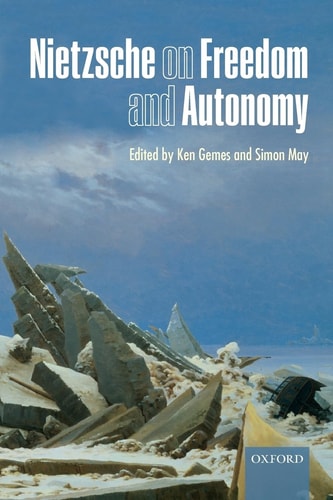
Nietzsche on Freedom and Autonomy
0
0
As an Amazon Associate and affiliate partner, Menrva Books earns from qualifying purchases. Learn more
Author Description
The principal aim of this volume is to elucidate what freedom, sovereignty, and autonomy mean for Nietzsche and what philosophical resources he gives us to re-think these crucial concepts. A related aim is to examine how Nietzsche connects these concepts to his thoughts about life-affirmation, self-love, promise-making, agency, the 'will to nothingness', and the 'eternal recurrence', as well as to his search for a 'genealogical' understanding of morality. These twelve essays by leading Nietzsche scholars ask such key questions as: Can we reconcile his rejection of free will with his positive invocations of the notion of free will? How does Nietzsche's celebration of freedom and free spirits sit with his claim that we all have an unchangeable fate? What is the relation between his concepts of freedom and self-overcoming? The depth in which these and related issues are explored gives this volume its value, not only to those interested in Nietzsche, but to all who are concerned with the free will debate, ethics, theory of action, and the history of philosophy.
Menrva's Summary
THE THESIS
This volume investigates the apparent contradictions in Friedrich Nietzsche’s philosophy regarding free will, autonomy, and the nature of human agency. The editors, Ken Gemes and Simon May, curate a collection of twelve essays from prominent scholars to analyze how Nietzsche’s rejection of traditional free will coexists with his advocacy for self-overcoming and the 'free spirit.' By applying a genealogical lens to these concepts, the contributors attempt to reconcile Nietzsche’s deterministic claims with his affirmative ethics.
THE SCOPE MAP
What You Will Find
- Analysis of Nietzschean concepts including eternal recurrence, promise-making, and the will to nothingness.
- Philosophical frameworks connecting self-love and agency to moral genealogy.
- Critical examination of the tension between fate and individual sovereignty.
Scope Limits
- The text does not provide a general biography of Nietzsche’s life.
- It does not offer a comprehensive overview of all Nietzschean thought, focusing specifically on freedom and autonomy.
THE AUTHORITY PERSPECTIVE
Scholars and students of philosophy frequently cite this collection as a rigorous resource for navigating the complexities of Nietzsche’s moral psychology. Experts highlight the volume for its ability to bridge the gap between Nietzsche’s historical context and contemporary debates in the theory of action.
Page Count:
293
Publication Date:
2009-01-01
Publisher:
OUP Oxford
ISBN-10:
0191607886
ISBN-13:
9780191607882
Philosophy
Non-Fiction
Ethics
Philosophy history
History & Surveys
Metaphysics
Liberty
Community Tags
Other Editions(3)

Similar Books