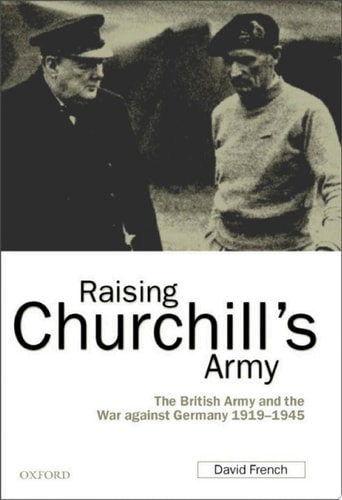
Raising Churchill's Army: The British Army and the War against Germany 1919-1945
0
0
As an Amazon Associate and affiliate partner, Menrva Books earns from qualifying purchases. Learn more
Author Description
This is the first serious analysis of the combat capability of the British army in the Second World War. It sweeps away the myth that the army suffered from poor morale, and that it only won its battles thorugh the use of 'brute force' and by reverting to the techniques of the First World War. David French analyses the place of the army in British strategy in the interwar period and during the Second World War. He shows that after 1918 the General Staff tried hard to learn the lessons of the First World War, enthusiastically embracing technology as the best way of minimizing future casualties. In the first half of the Second World War the army did suffer from manifold weaknesses, not just in the form of shortages of equipment, but also in the way in which it applied its doctrine. Few soldiers were actively eager to close with the enemy, but the morale of the army never collapsed and its combat capability steadily improved from 1942 onwards. Professor French assesses Montgomery's contributions to the war effort and concludes that most important were his willingness to impose a uniform understanding of doctrine on his subordinates, and to use mechanized firepower in ways quite different from Haig in the First World War.
Menrva's Summary
THE THESIS
This book investigates the combat capability and strategic evolution of the British Army between 1919 and 1945 to challenge prevailing myths regarding its performance. David French, a professor of military history, utilizes archival records and official doctrine to argue that the British Army underwent a calculated transformation, moving from interwar technological experimentation to a more effective application of mechanized firepower and unified doctrine during the Second World War. The text systematically refutes the notion that the army relied solely on brute force or suffered from systemic morale collapse.
THE SCOPE MAP
What You Will Find
- Analysis of British military strategy during the interwar period.
- Evaluation of the General Staff's approach to technological integration.
- Assessment of Field Marshal Montgomery's influence on tactical doctrine.
- Examination of combat capability trends from 1942 to 1945.
Scope Limits
- The study focuses primarily on the British Army and does not provide an exhaustive account of naval or aerial operations.
- It does not cover the post-1945 restructuring of the British military forces.
THE AUTHORITY PERSPECTIVE
Historians and military scholars frequently cite this work as a corrective text that provides a nuanced view of British tactical development. Readers often note the academic density of the prose, which is supported by extensive research into the institutional challenges faced by the British military command.
Page Count:
332
Publication Date:
2001-01-01
Publisher:
OUP Oxford
ISBN-10:
0191608262
ISBN-13:
9780191608261
History
Great Britain
Military History
British History
World War
European History
Military Strategy
Community Tags
Similar Books