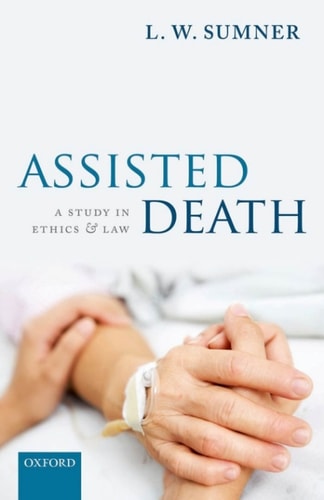
Assisted Death: A Study in Ethics and Law
0
0
As an Amazon Associate and affiliate partner, Menrva Books earns from qualifying purchases. Learn more
Author Description
Ethical and legal issues concerning physician-assisted suicide and euthanasia are very much on the public agenda in many jurisdictions. In this timely book L.W. Sumner addresses these issues within the wider context of palliative care for patients in the dying process. His ethical conclusion is that a bright line between assisted death and other widely accepted end-of-life practices, including the withdrawal of life-sustaining treatment, pain control through high-dose opioids, and terminal sedation, cannot be justified. In the course of the ethical argument many familiar themes are given careful and thorough treatment: conceptions of death, the badness of death, the wrongness of killing, informed consent and refusal, the ethics of suicide, cause of death, the double effect, the sanctity of life, the 'active/passive' distinction, advance directives, and nonvoluntary euthanasia. The legal discussion opens with a survey of some prominent prohibitionist and regulatory regimes and then outlines a model regulatory policy for assisted death. Sumner concludes by defending this policy against a wide range of common objections, including those which appeal to slippery slopes or the possibility of abuse, and by asking how the transition to a regulatory regime might be managed in three common law prohibitionist jurisdictions.
Menrva's Summary
THE THESIS
This book investigates the ethical and legal justifications for physician-assisted suicide and euthanasia within the context of modern palliative care. L.W. Sumner, a philosopher specializing in ethics and law, utilizes a rigorous analytical framework to challenge the distinction between assisted death and other accepted end-of-life practices. He argues that current prohibitions are logically inconsistent and proposes a model regulatory policy to govern assisted death in common law jurisdictions.
THE SCOPE MAP
What You Will Find
- Philosophical analysis of the sanctity of life and the wrongness of killing
- Examination of end-of-life practices including terminal sedation and withdrawal of treatment
- A proposed model regulatory policy for assisted death
- Comparative survey of existing prohibitionist and regulatory legal regimes
Scope Limits
- The text focuses primarily on common law jurisdictions and does not provide an exhaustive global legal survey
- The work prioritizes philosophical and legal argumentation over clinical medical protocols
THE AUTHORITY PERSPECTIVE
Scholars and legal professionals frequently cite this work for its systematic approach to the moral inconsistencies surrounding end-of-life legislation. Readers often note the academic density of the prose, which is intended for those seeking a structured philosophical defense of assisted death policies.
Page Count:
280
Publication Date:
2011-01-01
Publisher:
Oxford University Press
ISBN-10:
0191619442
ISBN-13:
9780191619441
Philosophy
Professional Career & Trade
Law
Euthanasia
Medical Law
Bioethics
Ethics
Sociology
Community Tags
Similar Books