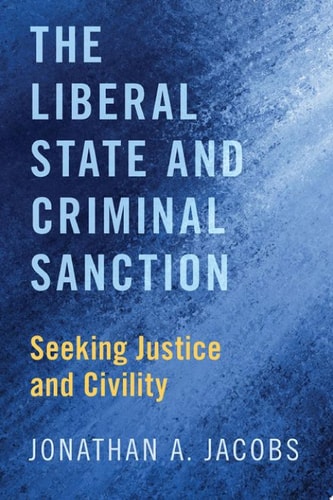
The Liberal State and Criminal Sanction: Seeking Justice and Civility
0
0
As an Amazon Associate and affiliate partner, Menrva Books earns from qualifying purchases. Learn more
Author Description
In a liberal democracy, theory suggests that the political order and character of a civil society are closely connected: the political order allows for a dynamic and pluralistic civil society, and people's civic participation encourages support for the political order. In examining the role of punishment in the U.S. and the U.K., however, Jonathan Jacobs maintains that the current state of incarceration is antithetical to the principles of a liberal democracy and betrays an abandonment of that project's essential values. The existing system imposes harsh injustices on incarcerated people: it subjects them to inhumane prison conditions, creates numerous obstacles that block their reentry into society upon release, and erodes their capacity to participate in civic life and exercise individual moral agency. And in recent decades, the number of its people that the U.S. has incarcerated has grown dramatically.Jacobs engages with substantial philosophical literature to argue that necessary and significant reforms to the U.S. and U.K. criminal justice systems demand a serious recommitment to the values and principles of a liberal democracy. Topics include the justification and aims of punishment, the role of criminal justice within theories of a just society, and empirical considerations regarding long-term incarceration and its impact. By comprehensively exploring the relationship between criminal justice and justice, he highlights distinctive elements of criminal justice as the basis for a retributivist conception of punishment that highlights desert and proportionality. Jacobs defends retributivism against familiar accusations that it approves vindictiveness and inevitably harms offenders, and shows how consequentialist approaches are seriously flawed. Drawing equally from both philosophy and criminology, Jacobs argues for a renewed dedication to the values and principles of a liberal democracy as critical to the possibility of criminal justice being truly just.
Menrva's Summary
THE THESIS
This book investigates whether the current systems of incarceration in the United States and the United Kingdom are compatible with the foundational principles of a liberal democracy. Jonathan A. Jacobs, a philosopher, utilizes a framework of political theory and criminology to argue that contemporary penal practices represent a failure to uphold the values of civic participation and moral agency. He contends that a just criminal justice system requires a rigorous application of retributivist principles, emphasizing proportionality and desert over flawed consequentialist models.
THE SCOPE MAP
What You Will Find
- A philosophical critique of current incarceration rates and prison conditions in the U.S. and U.K.
- An analysis of the relationship between political order and civil society
- A defense of retributivist punishment theories against common criticisms
- An examination of the barriers to reentry and civic reintegration for formerly incarcerated individuals
Scope Limits
- The text does not provide a comprehensive history of global penal systems outside of the U.S. and U.K.
- The work focuses primarily on theoretical and ethical justifications rather than offering a step-by-step policy manual for legislative reform.
THE AUTHORITY PERSPECTIVE
Scholars and readers frequently note the academic density of the prose, which requires a strong background in political philosophy to fully parse. Experts highlight this as a significant contribution to the intersection of legal theory and democratic ethics, particularly for those interested in the moral justification of state-sanctioned punishment.
Page Count:
278
Publication Date:
2020-01-01
Publisher:
Oxford University Press
ISBN-10:
0190863641
ISBN-13:
9780190863647
Philosophy
Sociology
Law
Ethics
Administration of Justice
Professional Career & Trade
Punishment
Liberalism
Civil society
Community Tags
Other Editions(2)
Similar Books








Reader Comments
Share Your Thoughts
No comments yet. Be the first to share your thoughts!