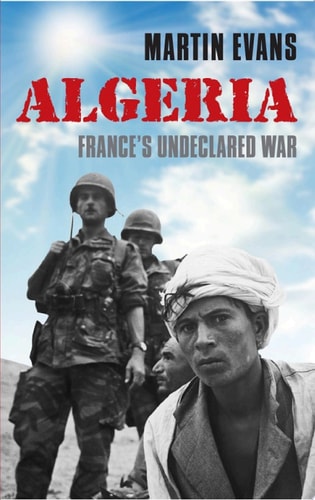
Algeria: France's Undeclared War
0
0
As an Amazon Associate and affiliate partner, Menrva Books earns from qualifying purchases. Learn more
Author Description
Invaded in 1830, populated by one million settlers who co-existed uneasily with nine million Arabs and Berbers, Algeria was different from other French colonies because it was administered as an integral part of France, in theory no different from Normandy or Brittany. The depth and scale of the colonization process explains why the Algerian War of 1954 to 1962 was one of the longest and most violent of the decolonization struggles. An undeclared war in the sense that there was no formal beginning of hostilities, the conflict produced huge tensions that brought down four governments, ended the Fourth Republic in 1958, and mired the French army in accusations of torture and mass human rights abuses. In carefully re-examining the origins and consequences of the conflict, Martin Evans argues that it was the Socialist-led Republican Front, in power from January 1956 until May 1957, which was the defining moment in the war, rather than the later administration under De Gaulle. Predicated on the belief in the universal civilizing mission of the Fourth Republic, coupled with the conviction that Algerian nationalism was feudal and religiously fanatical in character, the Republican Front dramatically intensified the war in the spring of 1956. Drawing upon previously classified archival sources as well as new oral testimonies, France's Undeclared War is the first major English-language history of the Algerian conflict in a generation. Throughout, Martin Evans underlines the ultimately irreconcilable conflict of values between the Republican Front and Algerian nationalism, explaining how this clash produced patterns of thought and action, such as the institutionalization of torture and the raising of pro-French Muslim militias, which tragically polarized choices and framed all stages of the conflict.
Menrva's Summary
THE THESIS
This work investigates the origins, escalation, and consequences of the Algerian War, specifically challenging the narrative that the conflict was primarily defined by the De Gaulle administration. Martin J. Evans, a historian specializing in modern French history, utilizes previously classified archival materials and oral testimonies to argue that the Socialist-led Republican Front (1956-1957) was the true catalyst for the war's intensification. He posits that the French government's rigid adherence to a 'civilizing mission' and its dismissal of Algerian nationalism as inherently fanatical created an irreconcilable ideological divide that necessitated violent state responses.
THE SCOPE MAP
What You Will Find
- Analysis of the French colonial administration from 1830 to 1962.
- Examination of the political collapse of the French Fourth Republic.
- Investigation into the institutionalization of torture and the use of pro-French Muslim militias.
- Comparative study of the Republican Front's policies versus later De Gaulle-era strategies.
Scope Limits
- The text focuses primarily on the French political and military perspective rather than providing a comprehensive social history of the Algerian civilian population.
- It does not provide an exhaustive military tactical history of every battle, focusing instead on political and institutional decision-making.
THE AUTHORITY PERSPECTIVE
Historians and scholars of decolonization recognize this text as a significant contribution to the English-language historiography of the Algerian conflict. Readers frequently note the academic density of the prose and the author's meticulous use of primary source materials to support his central argument.
Page Count:
494
Publication Date:
2011-01-01
Publisher:
OUP Oxford
ISBN-10:
0191619965
ISBN-13:
9780191619960
History
European History
Military History
Algeria history
Colonialism
France
Community Tags
Similar Books