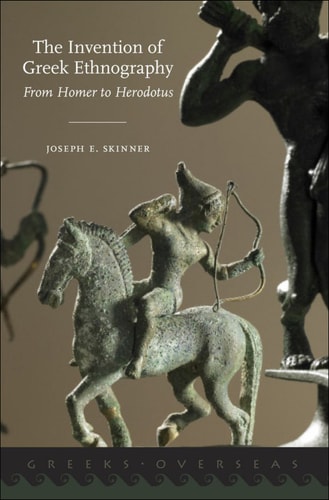
The Invention of Greek Ethnography: From Homer to Herodotus
0
0
As an Amazon Associate and affiliate partner, Menrva Books earns from qualifying purchases. Learn more
Author Description
Greek ethnography is commonly believed to have developed in conjunction with the wider sense of Greek identity that emerged during the Greeks' "encounter with the barbarian"--Achaemenid Persia--during the late sixth to early fifth centuries BC. The dramatic nature of this meeting, it was thought, caused previous imaginings to crystallise into the diametric opposition between "Hellene" and "barbarian" that would ultimately give rise to ethnographic prose. The Invention of Greek Ethnography challenges the legitimacy of this conventional narrative. Drawing on recent advances in ethnographic and cultural studies and in the material culture-based analyses of the Ancient Mediterranean, Joseph Skinner argues that ethnographic discourse was already ubiquitous throughout the archaic Greek world, not only in the form of texts but also in a wide range of iconographic and archaeological materials. As such, it can be differentiated both on the margins of the Greek world, like in Olbia and Calabria and in its imagined centers, such as Delphi and Olympia. The reconstruction of this "ethnography before ethnography" demonstrates that discourses of identity and difference played a vital role in defining what it meant to be Greek in the first place long before the fifth century BC. The development of ethnographic writing and historiography are shown to be rooted in this wider process of "positioning" that was continually unfurling across time, as groups and individuals scattered the length and breadth of the Mediterranean world sought to locate themselves in relation to the narratives of the past. This shift in perspective provided by The Invention of Greek Ethnography has significant implications for current understanding of the means by which a sense of Greek identity came into being, the manner in which early discourses of identity and difference should be conceptualized, and the way in which so-called "Great Historiography," or narrative history, should ultimately be interpreted.
Menrva's Summary
THE THESIS
Does the conventional narrative that Greek ethnography emerged solely from the fifth-century BC conflict with Achaemenid Persia accurately reflect the origins of Hellenic identity? Joseph E. Skinner, a scholar of classical antiquity, challenges the traditional historiographical consensus by arguing that ethnographic discourse was already pervasive throughout the archaic Greek world. By synthesizing material culture, iconographic evidence, and textual analysis, Skinner posits that identity formation was a continuous process of positioning that predates the Persian Wars, fundamentally reshaping our understanding of how the Greeks defined themselves in relation to the 'barbarian' other.
THE SCOPE MAP
What You Will Find
- Analysis of archaic Greek identity formation across the Mediterranean, including regions like Olbia and Calabria.
- Examination of iconographic and archaeological materials alongside traditional literary texts.
- A critical re-evaluation of the 'Hellene versus barbarian' binary as a late development.
- A framework for interpreting the roots of narrative history and 'Great Historiography' in the context of early cultural positioning.
THE AUTHORITY PERSPECTIVE
Scholars and historians recognize this work as a significant intervention in the study of ancient identity and the development of historiography. Readers frequently note the academic density of the prose, which requires a foundational knowledge of classical texts and archaeological methodology to fully appreciate the author's argument.
Page Count:
348
Publication Date:
2012-01-01
Publisher:
Oxford University Press
ISBN-10:
0199996318
ISBN-13:
9780199996315
History
Anthropology
History - Ancient
Ethnology
Archaeology
Historiography
English & College Success
English
Greece
Modern Greek
Ancient History
Community Tags
Other Editions(2)
Similar Books















Reader Comments
Share Your Thoughts
No comments yet. Be the first to share your thoughts!