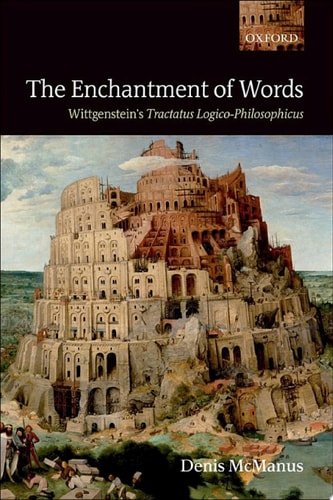
The Enchantment of Words: Wittgenstein's Tractatus Logico-Philosophicus
0
0
As an Amazon Associate and affiliate partner, Menrva Books earns from qualifying purchases. Learn more
Author Description
Recent years have seen a great revival of interest in Wittgenstein's early masterpiece, the Tractatus Logico-Philosophicus. The Enchantment of Words is a study of that book, offering novel readings of all its major themes and shedding light on issues in metaphysics, ethics and the philosophies of mind, language, and logic. McManus argues that Wittgenstein's aim in this deeply puzzling work is to show that the 'intelligibility of thought' and the 'meaningfulness of language', which logical truths would delimit and metaphysics and the philosophy of mind and language would explain, are issues constituted by confusions. What is exposed is a mirage of a kind of self-consciousness, a misperception of the ways in which we happen to think, talk and act as reasons why we ought to think, talk and act as we do. The root of that misperception is our confusedly endowing words with a life of their own: we 'enchant', and are 'enchanted by', words, colluding in a confusion that transposes on to them, and the world which we then see them as 'fitting', responsibilities that are actually ours to bear. Such words promise to spare us the trouble, not only of thinking, but of living. In presenting this view, McManus offers readings of all of the major themes of the Tractatus, including its discussion of logical truth, objects, names, inference, subjectivity, solipsism and the ineffable; McManus offers novel explanations of what is at stake in Wittgenstein's comparison of propositions with pictures, of why Wittgenstein declared the point of the Tractatus to be ethical, of how a bookwhich infamously declares itself to be nonsensical can both clarify our thoughts and require of us that we exercise our capacity to reason in reading it, and of how Wittgenstein later came to re-evaluate the achievement of the Tractatus.
Menrva's Summary
THE THESIS
How does the Tractatus Logico-Philosophicus function as a critique of the ways in which we misinterpret the nature of language and thought? Denis McManus, a scholar of Wittgenstein, argues that the early work is not merely a failed attempt at logical construction but a deliberate exposure of the confusions inherent in our philosophical inquiries. By examining the 'enchantment' of words, McManus posits that Wittgenstein sought to reveal how we project our own responsibilities onto language, creating a mirage of self-consciousness that obscures our actual modes of thinking and acting.
THE SCOPE MAP
What You Will Find
- Analysis of major Tractarian themes including logical truth, objects, names, and solipsism.
- A re-evaluation of the 'picture theory' of propositions.
- An exploration of the ethical dimensions of Wittgenstein's early philosophy.
- Discussion on the paradox of a text that claims to be nonsensical while demanding rigorous reasoning.
Scope Limits
- The text focuses primarily on the early philosophy of Wittgenstein and does not provide a comprehensive history of 20th-century analytic philosophy.
- It does not serve as a general introduction to logic but assumes familiarity with the Tractatus.
THE AUTHORITY PERSPECTIVE
Scholars recognize this work as a significant contribution to the 'resolute' reading of Wittgenstein, offering a coherent framework for understanding the text's notoriously difficult conclusion. Readers frequently note the academic density of the prose, which requires a high level of engagement with the original source material.
Page Count:
292
Publication Date:
2010-01-01
Publisher:
Clarendon Press
ISBN-10:
019161503X
ISBN-13:
9780191615030
Philosophy
Ethics
Wittgenstein
Language
Logic
Metaphysics
History & Surveys
Community Tags
Similar Books