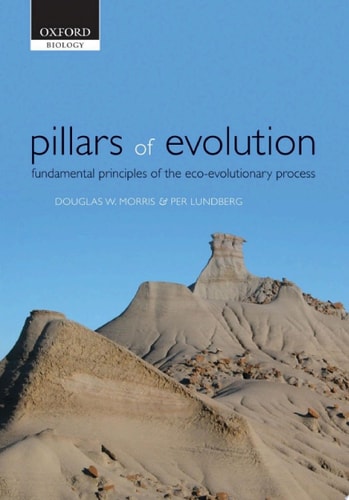
Pillars of Evolution: Fundamental Principles of the Eco-Evolutionary Process
0
0
As an Amazon Associate and affiliate partner, Menrva Books earns from qualifying purchases. Learn more
Author Description
Pillars of Evolution provides a fresh and provocative perspective on adaptive evolution. Readers new to the study of evolution will find a refreshing new insight that establishes evolutionary biology as a rigorous and predictive science, whilst practicing biologists will discover a provocative book that challenges traditional approaches. The book begins by leading readers through the mechanics of heredity, reproduction, movement, survival, and development. With that framework in place, it then explores the numerous ways that traits emerge from the interactions between genetics, development, and the environment. The key message is that adaptive changes in traits (and their underlying allelic frequencies) evolve through the traits' functions and their connection with fitness. The complex mappings from genes-to-traits-to-fitness are characterized in the structure of evolution. A single "structure matrix" describes why individuals vary in the values of adaptive traits, their ability to perform the function of those traits, and in the fitness they accrue. Fitness depends on how organisms interact with and perceive their environment in time and space. These relationships are made explicit in spatial, temporal, and organizational scale that also sets the stage for the crucially important role that ecology always plays in evolution. The ecological hallmarks of density- and frequency-dependent interactions allow the authors to explore new and exciting insights into evolution's dynamics. The theories and principles are then brought together in a final synthesis on adaptation. The book's unique approach unites genetic, development, and environmental influences into a single comprehensive treatment of the eco-evolutionary process.
Menrva's Summary
THE THESIS
This book investigates how the integration of genetics, development, and environmental interactions establishes evolutionary biology as a rigorous, predictive science. Authors Douglas W. Morris and Per Lundberg utilize a framework centered on the "structure matrix" to explain how adaptive traits emerge and influence fitness. By connecting allelic frequencies to functional traits and environmental perception, the authors argue that ecology is an inseparable component of the evolutionary process.
THE SCOPE MAP
What You Will Find
- A comprehensive framework for the genes-to-traits-to-fitness mapping process.
- The application of the structure matrix to quantify individual variation in adaptive traits.
- Analysis of density- and frequency-dependent interactions in ecological settings.
Scope Limits
- The text does not provide an exhaustive history of evolutionary thought or a survey of paleontology.
- It focuses primarily on the theoretical mechanics of eco-evolutionary processes rather than applied conservation biology.
THE AUTHORITY PERSPECTIVE
Experts recognize this work as a specialized text that bridges the gap between traditional genetics and ecological dynamics. Readers frequently note the academic density of the prose, which is intended for biologists and advanced students seeking a unified theoretical approach to adaptation.
Page Count:
296
Publication Date:
2011-01-01
Publisher:
OUP Oxford
ISBN-10:
0191626589
ISBN-13:
9780191626586
Science
Genetics
Evolutionary Biology
Evolution
Ecology
Academic
Community Tags
Other Editions(3)

Similar Books








Reader Comments
Share Your Thoughts
No comments yet. Be the first to share your thoughts!