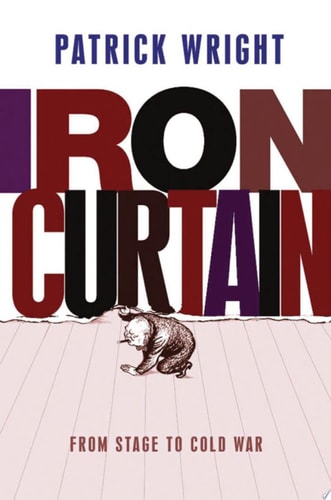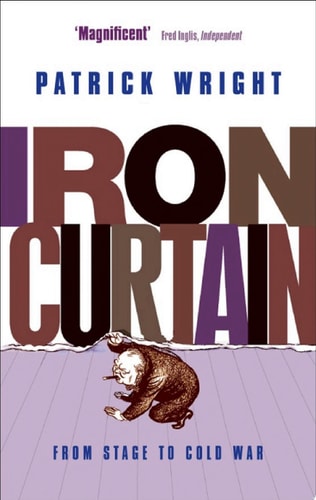
Iron Curtain: From Stage to Cold War
0
0
As an Amazon Associate and affiliate partner, Menrva Books earns from qualifying purchases. Learn more
Author Description
'From Stettin in the Baltic to Trieste in the Adriatic an iron curtain has descended across the Continent...' With these words Winston Churchill famously warned the world in a now legendary speech given in Fulton, Missouri, on March 5, 1946. Launched as an evocative metaphor, the 'Iron Curtain' quickly became a brutal reality in the Cold War between Capitalist West and Communist East. Not surprisingly, for many years, people on both sides of the division have assumed that the story of the Iron Curtain began with Churchill's 1946 speech. In this pioneering investigation, Patrick Wright shows that this was decidedly not the case. Starting with its original use to describe an anti-fire device fitted into theatres, Iron Curtain tells the story of how the term evolved into such a powerful metaphor and the myriad ways in which it shaped the world for decades before the onset of the Cold War. Along the way, it offers fascinating perspectives on a rich array of historical characters and developments, from the lofty aspirations and disappointed fate of early twentieth century internationalists, through the topsy-turvy experiences of the first travellers to Soviet Russia, to the theatricalization of modern politics and international relations. Ultimately, as Wright reveals, the term captures a particular way of thinking about the world that long pre-dates the Cold War. In reality, the iron curtain was never just a frontier - it was a psychological state, and it did not simply disappear with the Berlin Wall.
Menrva's Summary
THE THESIS
How did the term 'Iron Curtain' evolve from a theatrical safety mechanism into the defining geopolitical metaphor of the twentieth century? Patrick Wright, a cultural historian, investigates the linguistic and political origins of this phrase, arguing that its significance predates Winston Churchill's 1946 speech. By examining early twentieth-century internationalism and the psychological framing of borders, Wright demonstrates that the concept functioned as a mental construct long before it became a physical barrier.
THE SCOPE MAP
What You Will Find
- The etymological transition of 'iron curtain' from nineteenth-century theater architecture to political rhetoric.
- Analysis of early twentieth-century travelogues and accounts from visitors to Soviet Russia.
- Examination of the theatricalization of modern political discourse and international relations.
Scope Limits
- The text does not provide a comprehensive military history of the Cold War.
- It does not focus on the technical construction or engineering of the physical Berlin Wall.
THE AUTHORITY PERSPECTIVE
Scholars and historians recognize this work as a nuanced cultural study that challenges conventional narratives regarding the Cold War's origins. Readers frequently note the intellectual density of the prose and the author's ability to connect disparate historical threads into a cohesive argument.
Page Count:
505
Publication Date:
2009-01-01
Publisher:
OUP Oxford
ISBN-10:
0191622842
ISBN-13:
9780191622847
History
European History
Cold War
Etymology
Cultural History
Community Tags
Similar Books