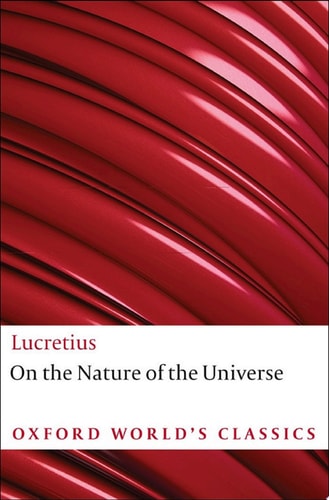
On the Nature of the Universe
0
0
As an Amazon Associate and affiliate partner, Menrva Books earns from qualifying purchases. Learn more
Author Description
Therefore this terror and darkness of the mind Not by the sun's rays, nor the bright shafts of day, Must be dispersed, as is most necessary, But by the face of nature and her laws.' Lucretius' poem On the Nature of the Universe combines a scientific and philosophical treatise with some of the greatest poetry ever written. With intense moral fervour Lucretius demonstrates to humanity that in death there is nothing to fear since the soul is mortal, and the world and everything in it is governed not by the gods, but by the mechanical laws of nature. By believing this, men can live in peace of mind and happiness. Lucretius bases his argument on the atomic theory expounded by the Greek philosopher Epicurus. His poem explores sensation, sex, cosmology, meteorology, and geology through acute observation of the beauties of the natural world and with moving sympathy for man's place in it. Sir Ronald Melville's accessible and accurate verse translation is complemented by an introduction and notes situating Lucretius' scientific theories within the thought of 1st century BCE Rome and discussing the Epicurean philosophy that was his inspiration and why the issues Lucretius' poem raisies about the scientific and poetical views of the world continue to be important. ABOUT THE SERIES: For over 100 years Oxford World's Classics has made available the widest range of literature from around the globe. Each affordable volume reflects Oxford's commitment to scholarship, providing the most accurate text plus a wealth of other valuable features, including expert introductions by leading authorities, helpful notes to clarify the text, up-to-date bibliographies for further study, and much more.
Menrva's Summary
THE THESIS
How can humanity overcome the fear of death and achieve peace of mind through an understanding of the material world? Lucretius, a Roman poet and philosopher, argues that the universe is governed by mechanical laws rather than divine intervention. By utilizing the atomic theory of Epicurus, the author posits that the soul is mortal and that understanding the natural order allows individuals to live without the burden of superstition or existential dread.
THE SCOPE MAP
What You Will Find
- A comprehensive verse translation of the didactic poem De Rerum Natura.
- Explanations of Epicurean physics, including atomic theory, cosmology, and meteorology.
- Scholarly apparatus including an introduction, historical notes, and contextual analysis of 1st century BCE Roman thought.
Scope Limits
- This volume focuses on the Epicurean interpretation of natural philosophy and does not provide a comparative analysis of competing schools of thought like Stoicism in equal depth.
THE AUTHORITY PERSPECTIVE
Scholars and readers frequently cite this edition for its accessible verse translation and the clarity of its accompanying scholarly notes. It is widely regarded as a foundational text for students and general readers seeking to understand the intersection of ancient science and philosophical poetry.
Page Count:
320
Publication Date:
2008-01-01
Publisher:
OUP Oxford
ISBN-10:
019162327X
ISBN-13:
9780191623271
Philosophy
Science
Poetry
English & College Success
Ancient History
Epicureanism
English
Classical
Community Tags
Similar Books