The Man Who Disappeared
0
0
As an Amazon Associate and affiliate partner, Menrva Books earns from qualifying purchases. Learn more
Author Description
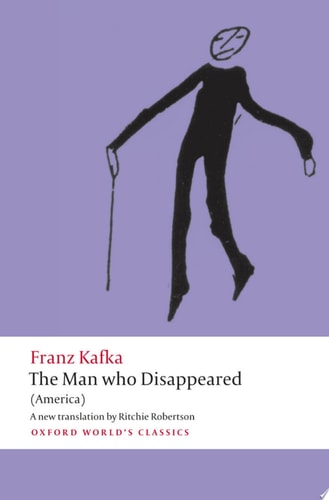
'...behind them all was New York, looking at Karl with the hundred thousand windows of its skyscrapers' Entering New York harbour, the young immigrant Karl Rossmann sees the Statue of Liberty, 'her arm with the sword stretched upward'. This forbidding introduction sets the tone for Kafka's narrative about an innocent European astray in an ultra-modern America that is both a fantasy and an object of social satire. Expelled by his family after seduction by a maidservant, Karl finds in America a series of surrogate families, but he continues to get into undeserved trouble and is forced to move on once again. Along the way Karl encounters extremes of wealth and poverty, experiences the cruelty of the American work ethic, and has glimpses of the criminal underworld, without losing the basic goodness and resourcefulness that enable him to survive the hazards of the New World. Full of incident, and blackly humorous, Kafka's first novel portrays American civilization with horrified fascination. This edition retains Kafka's distinctive style in a sensitive and natural new translation, together with a penetrating introduction and notes. ABOUT THE SERIES: For over 100 years Oxford World's Classics has made available the widest range of literature from around the globe. Each affordable volume reflects Oxford's commitment to scholarship, providing the most accurate text plus a wealth of other valuable features, including expert introductions by leading authorities, helpful notes to clarify the text, up-to-date bibliographies for further study, and much more.
Menrva's Summary
THE PULSE
After being exiled from his home in Europe, young Karl Rossmann arrives in an unfamiliar America where he must navigate a series of increasingly bizarre and bureaucratic social traps. Karl seeks stability and acceptance within various surrogate families, yet he is consistently undermined by forces beyond his control, including rigid social hierarchies and the cold indifference of an industrialized society. The narrative follows a linear but dreamlike progression, utilizing a third-person perspective that maintains a detached, observational tone. As Karl moves from one precarious situation to the next, he faces physical displacement and logical absurdities that challenge his inherent innocence and resourcefulness.
INSIDE THE PAGES
- Surrealist depiction of early 20th-century American urban environments
- Exploration of the immigrant experience and social alienation
- Episodic narrative structure mirroring a picaresque format
- Satirical critique of industrial work ethics and class structures
- Recurring motifs of bureaucratic entrapment and institutional power
- Contrast between individual innocence and systemic cruelty
- Use of dark humor to highlight the protagonist's misfortune
- Detailed descriptions of architectural and social spaces as psychological barriers
THE COLLECTIVE ECHO
Readers and critics often note the distinct departure this novel takes from the claustrophobic atmosphere of Kafka's later works, highlighting its more expansive and episodic nature. Discussion frequently centers on the author's imaginative, albeit distorted, perception of American civilization as a land of both opportunity and nightmarish bureaucracy. Many highlight the effectiveness of the protagonist's persistent, quiet resilience in the face of an increasingly nonsensical world. The balance between the novel's satirical intent and its underlying sense of existential dread remains a primary focus for scholars. Readers often find the work's blend of social commentary and surrealist imagery to be a compelling look at the vulnerability of the individual within a modernizing society.
Page Count:
254
Publication Date:
2012-01-01
Publisher:
OUP Oxford
ISBN-10:
0191627062
ISBN-13:
9780191627064
Literary Fiction
Satire
Surrealism
English & College Success
classic
English
European