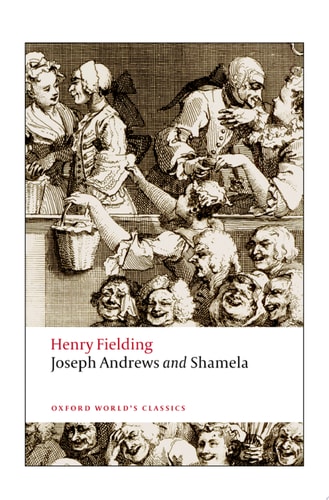
Joseph Andrews and Shamela
0
0
As an Amazon Associate and affiliate partner, Menrva Books earns from qualifying purchases. Learn more
Author Description
'I beg as soon as you get Fielding's Joseph Andrews, I fear in Ridicule of your Pamela and of Virtue in the Notion of Don Quixote's Manner, you would send it to me by the very first Coach.' (George Cheyne in a letter to Samuel Richardson, February 1742) Both Joseph Andrews (1742) and Shamela (1741) were prompted by the success of Richardson's Pamela (1740), of which Shamela is a splendidly bawdy parody. But in Shamela Fielding also demonstrates his concern for the corruption of contemporary society, politics, religion, morality, and taste. The same themes - together with a presentation of love as charity, as friendship, and in its sexual taste - are present in Joseph Andrews, Fielding's first novel. It is a work of considerable literary sophistication and satirical verve, but its appeal lies also in its spirit of comic affirmation, epitomized in the celebrated character of Parson Adams. This revised and expanded edition follows the text of Joseph Andrews established by Martin C. Battestin for the definitive Wesleyan Edition of Fielding's works. The text of Shamela is based on the first edition, and two substantial appendices reprint the preliminary matter from Conyers Middleton's Life of Cicero and the second edition of Richardson's Pamela (both closely parodied in Shamela). A new introduction by Thomas Keymer situates Fielding's works in their critical and historical contexts. ABOUT THE SERIES: For over 100 years Oxford World's Classics has made available the widest range of literature from around the globe. Each affordable volume reflects Oxford's commitment to scholarship, providing the most accurate text plus a wealth of other valuable features, including expert introductions by leading authorities, helpful notes to clarify the text, up-to-date bibliographies for further study, and much more.
Menrva's Summary
THE PULSE
The narrative centers on the moral and social subversion of contemporary virtue through the lens of parody and picaresque adventure. Following the success of Samuel Richardson's Pamela, Henry Fielding crafts a satirical response that challenges the perceived hypocrisy of the original work. Joseph Andrews follows the titular character as he navigates a series of misadventures, while Shamela serves as a direct, bawdy inversion of the archetypal virtuous heroine. The narrative framework utilizes irony and social commentary to expose the corruption inherent in 18th-century religious and political institutions.
INSIDE THE PAGES
- Picaresque structure involving episodic travel and encounters
- Direct parody of Samuel Richardson's epistolary style
- Satirical characterization of social and religious hypocrisy
- Inclusion of the iconic, eccentric figure of Parson Adams
- Exploration of love as charity, friendship, and physical desire
- Use of mock-heroic language and classical allusions
- Commentary on contemporary morality and societal taste
- Critical appendices providing historical context for the parodied source material
THE COLLECTIVE ECHO
Readers and critics frequently highlight the sharp contrast between the overt bawdiness of Shamela and the more nuanced, expansive satire found in Joseph Andrews. Discussion often centers on Fielding's ability to balance biting social critique with a genuine spirit of comic affirmation. Scholars emphasize the importance of Parson Adams as a vehicle for the author's moral philosophy, noting his role in grounding the narrative's more absurd elements. The work is widely regarded as a foundational text for understanding the development of the English novel and the evolution of satirical prose in the 18th century.
Page Count:
464
Publication Date:
2008-01-01
Publisher:
OUP Oxford
ISBN-10:
0192669273
ISBN-13:
9780192669278
Satire
Humorous fiction
18th century
Classic Literature
English & College Success
English
England
Clergy
Parody
Community Tags
Other Editions(3)

Similar Books





Reader Comments
Share Your Thoughts
No comments yet. Be the first to share your thoughts!